The short answer
A prefix goes on the front of a base word and changes its meaning, and the base word keeps every letter: mis and spell make misspell, and un and necessary make unnecessary. Teach un- and re- in 2nd grade, dis-, mis- and pre- in 3rd, sub-, over-, non- and inter- in 4th, and in-, im-, il- and ir- in 5th.
A prefix is a word part added to the front of a base word to change what it means. Un and safe make unsafe, and re and wind make rewind. The spelling rule is short: the base word keeps every letter, and the prefix goes in front of it. This guide covers the common prefixes for 2nd to 5th grade, with the meaning of each one, the spelling rule, the order to teach them and a word list for each grade.
The spelling rule: keep the base word whole
The rule. Write the prefix, then write the base word exactly as it is. Mis and spell make misspell, and un and necessary make unnecessary, so both words end up with a double letter. The Rhode Island Department of Education calls prefixes such as un-, re- and pre- stable, because they keep their spelling whatever base word they join. The spelling appendix to England’s national curriculum says the same of most prefixes: they go on “without any changes in spelling.” The in- family is the one exception, and it has its own section below.
The split check. Before writing a long word, split it where the prefix ends: mis | step, un | necessary, ir | relevant. A double letter belongs only where the prefix ends with the letter the base word starts with. Misstep and irresistible have one. Disagree doesn’t, because agree starts with a.
Common prefixes and what they mean
| Prefix | Meaning | Examples | Grade |
|---|---|---|---|
| un- | not, or the opposite of an action | unsafe, unbutton | 2nd |
| re- | again, or back | reread, rewind | 2nd |
| dis- | not, or the opposite of | dishonest, disapprove | 3rd |
| mis- | badly or wrongly | misprint, misuse | 3rd |
| pre- | before, or in advance | pretest, preorder | 3rd |
| sub- | under or below, or a smaller part | subzero, subset | 4th |
| over- | too much, or beyond | oversleep, overdue | 4th |
| non- | not | nonstop, nonliving | 4th |
| inter- | between or among | interact, intersection | 4th |
| in-, im-, il-, ir- | not | incomplete, impolite, illogical, irrelevant | 5th |
Each prefix links to its Merriam-Webster entry, where the meaning comes from. A What Works Clearinghouse practice guide on reading interventions for grades 4 to 9 ranks un-, re-, in- (with im-, il- and ir-) and dis- as the four most frequent prefixes, and suggests starting with common ones such as un-, re- and dis-.
The order to teach prefixes
The Common Core names prefixes from 2nd grade on but gives only examples, not a list per grade. This order follows those examples and the frequency ranking above:
- 2nd grade: un- and re-. They are the two most frequent prefixes, and the 2nd-grade examples are happy and unhappy, and tell and retell.
- 3rd grade: dis-, mis- and pre-. Students are expected to know “the most common prefixes,” and the 3rd-grade examples include agreeable and disagreeable, and heat and preheat.
- 4th grade: sub-, over-, non- and inter-. The standards move to Greek and Latin affixes and longer words that students break into parts.
- 5th grade: in-, im-, il- and ir-. The meaning is easy, but choosing the form takes a careful look at the base word.
2nd grade: un- and re-
The rule. un- means not on a describing word (unsafe, unsure, unclear) and the opposite of an action on a doing word (unbutton, unload). re- means again (redo, reread, rename) or back (rewind).
The quick check. Swap the prefix for its meaning. Unsafe is not safe, and reread is read again. If the swap turns into nonsense, the letters aren’t a prefix: unit isn’t “not it,” and rest isn’t “st again.”
2nd grade: un- and re-
Say each word as its meaning first: unload is the opposite of load, and rewind is wind back.
- unbutton
- unload
- unsafe
- unsure
- unclear
- redo
- reread
- rewind
- rename
- reload
For more lists at this level, see the 2nd grade spelling words.
3rd grade: dis-, mis- and pre-
The rule. dis- means not or the opposite of: dishonest, distrust, disapprove. mis- means badly or wrongly: misprint, misuse, misinform. pre- means before: pretest, preorder, precut.
The quick check. Say the meaning, then split the word to look for a double letter. Mis | step has two s’s, and dis | honest has one.
Exceptions. Plenty of words start with these letters and have no prefix at all, such as pretty, press and mist. The meaning check catches them, because pretty isn’t “before tty.”
3rd grade: dis-, mis- and pre-
Split each word before writing it. Misstep has two s’s because step starts with s. Dishonest has one.
- dishonest
- distrust
- disapprove
- misprint
- misuse
- misstep
- misinform
- pretest
- preorder
- precut
The 3rd grade spelling words have more lists for this grade.
4th grade: sub-, over-, non- and inter-
The rule. sub- means under or below, or a smaller part of something: subzero, subset, subtotal. over- means too much or beyond: oversleep, overdue. non- means not: nonstop, nonliving. inter- means between or among: interact, intersection.
The quick check. Put the meaning in front of the base word: below zero, sleep too long, not living. If the phrase matches the word, the prefix and its spelling are right.
Hyphens. Merriam-Webster writes nonfiction, nonstop and nonliving as single words, with no hyphen, and the same goes for subzero and overdue.
4th grade: sub-, over-, non- and inter-
Read each one as its meaning: subzero is below zero, oversleep is sleep too long, and nonliving is not living.
- subzero
- subset
- subtotal
- oversleep
- overdue
- nonstop
- nonfiction
- nonliving
- interact
- intersection
The 4th grade spelling words have more lists for this grade.
5th grade: in-, im-, il- and ir-
The rule. All four mean not. Merriam-Webster’s entry for in- gives the pattern: usually im- before b, m or p (imbalance, immovable, impolite), il- before l (illogical), ir- before r (irrelevant), and in- before other sounds (incomplete, informal). The Rhode Island guidance explains why: the prefix takes its last letter from the base word because that is easier to say. Try saying “inrelevant.”
The quick check. Look at the first letter of the base word and pick the form. Because il- always meets an l and ir- always meets an r, illogical and irrelevant always have a double letter, and so does immovable.
Exceptions. Not every in means not. In inside and indoor it means in. Two words look like opposites and aren’t: invaluable means priceless, and inflammable means the same as flammable. Some base words take un- for not instead, such as unable and unequal, so learn those word by word.
5th grade: in-, im-, il- and ir-
All four mean not. The first letter of the base word picks the form: im- before b, m or p, il- before l, ir- before r, and in- before the rest.
- incomplete
- inaccurate
- informal
- impolite
- imperfect
- immovable
- illogical
- illegible
- irrelevant
- irresistible
For longer words at this level, see the 5th grade spelling words.
Practicing prefixes with a class link
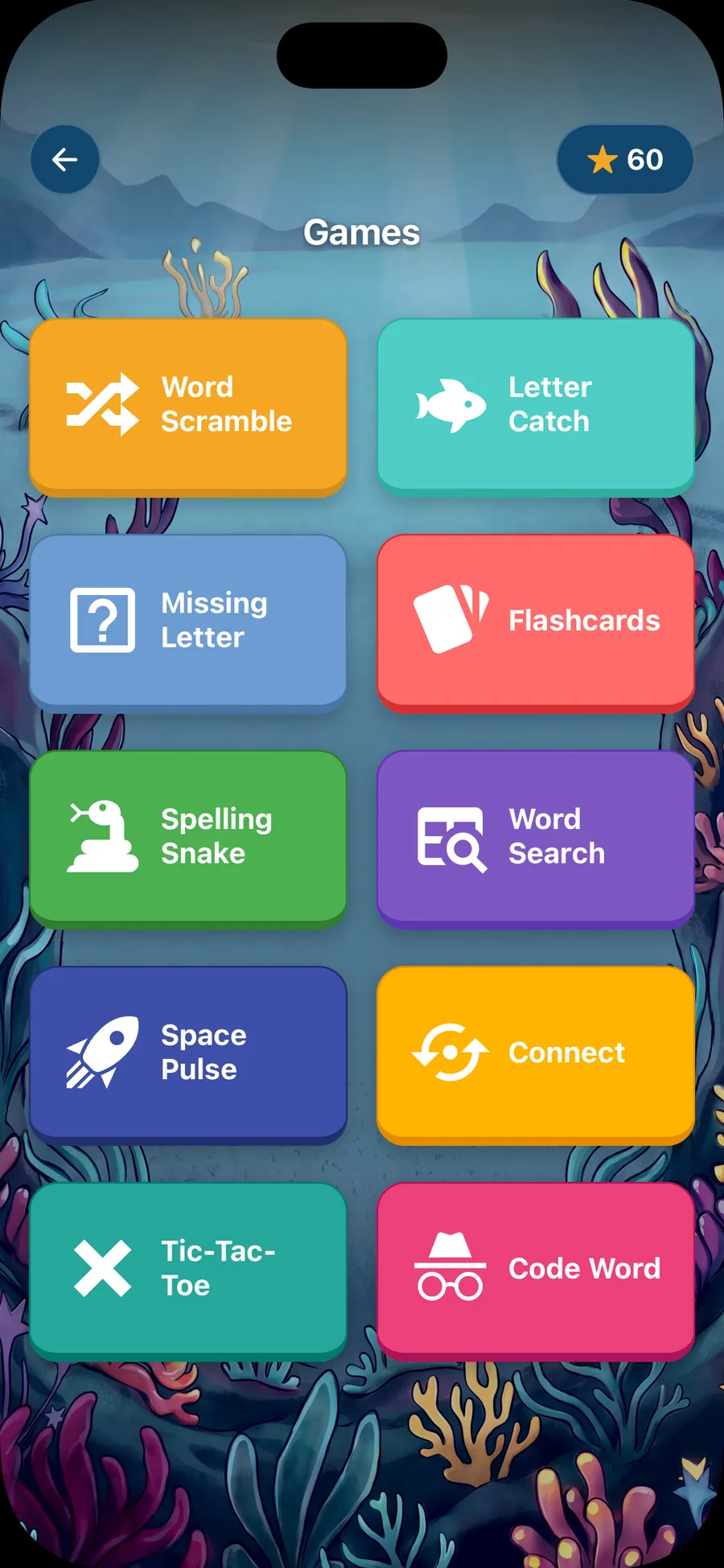
Spelling Stream for Teachers turns a word list into games your class plays in any web browser, with each word read aloud in US English. It’s free, with no student logins and no ads. Press Make it a class list under any set above, change the words if you like, and share one link.
- In Flashcards, students say the meaning before they spell the word out loud: “mis, wrongly, use: m-i-s-u-s-e.”
- In Scramble, a student who spots the prefix letters first has the rest of the word left to build, and the base word is one they already know.
- Missing letter can hide up to three letters, and students can type them instead of tapping tiles. A gap on a double letter, as in mis_tep, is a good test of the split check.
Once students know a few prefixes, try a word family list: one base word with several prefixes, such as load, unload, reload and overload. A list holds up to 40 words. At home, families can open the class list in the free Spelling Stream app and keep practicing on their own device, and the spelling homework ideas fit any of these lists.
Where prefixes sit in the Common Core
The word sets are original. They are built on these Common Core State Standards for English Language Arts:
- L.2.4b (2nd grade): “Determine the meaning of the new word formed when a known prefix is added to a known word (e.g., happy/unhappy, tell/retell).”
- RF.3.3a (3rd grade): “Identify and know the meaning of the most common prefixes and derivational suffixes.”
- L.3.4b (3rd grade): “Determine the meaning of the new word formed when a known affix is added to a known word (e.g., agreeable/disagreeable, comfortable/uncomfortable, care/careless, heat/preheat).”
- L.3.2f (3rd grade): “Use spelling patterns and generalizations (e.g., word families, position-based spellings, syllable patterns, ending rules, meaningful word parts) in writing words.”
- RF.4.3a (4th grade): “Use combined knowledge of all letter-sound correspondences, syllabication patterns, and morphology (e.g., roots and affixes) to read accurately unfamiliar multisyllabic words in context and out of context.”
- L.4.4b (4th grade): “Use common, grade-appropriate Greek and Latin affixes and roots as clues to the meaning of a word (e.g., telegraph, photograph, autograph).”
- L.4.2d (4th grade): “Spell grade-appropriate words correctly, consulting references as needed.”
- L.5.4b (5th grade): “Use common, grade-appropriate Greek and Latin affixes and roots as clues to the meaning of a word (e.g., photograph, photosynthesis).”
- L.5.2e (5th grade): “Spell grade-appropriate words correctly, consulting references as needed.”
Many states publish their own English language arts standards, which can differ from the Common Core, so check this order against your state’s standards and your school’s scope and sequence.
Sources: Common Core State Standards for English Language Arts, What Works Clearinghouse, Providing Reading Interventions for Students in Grades 4–9, Rhode Island Department of Education, Morphology Influences Spelling, England’s national curriculum, spelling appendix, Merriam-Webster.
Standards quoted from the Common Core State Standards for English Language Arts under the Common Core State Standards Public License. © Copyright 2010. National Governors Association Center for Best Practices and Council of Chief State School Officers. All rights reserved. The National Governors Association Center for Best Practices and the Council of Chief State School Officers are the sole owners and developers of the Common Core State Standards. They did not make these word sets and do not endorse Spelling Stream for Teachers. Common Core State Standards Public License.
Questions
Is it misspell or mispell?
Misspell, with two s’s. It is the prefix mis- (wrongly) and the base word spell, and a prefix never takes a letter away from the base word. Misstep and dissatisfied keep a double letter for the same reason.
What are the most common prefixes?
A What Works Clearinghouse practice guide from the US Department of Education ranks un-, re-, in- (with im-, il- and ir-) and dis- as the four most frequent. Its top twelve also include en- and em-, non-, over-, mis-, sub-, pre- and inter-.
When do you use im- instead of in-?
Before a base word that starts with b, m or p: imbalance, immovable, impolite. Use il- before l (illogical), ir- before r (irrelevant), and in- before other letters (incomplete). All four mean not.
Which prefixes do 3rd graders learn?
The Common Core asks 3rd graders to know “the most common prefixes,” and its 3rd-grade examples include disagreeable, uncomfortable and preheat. That makes dis-, mis- and pre- a good fit, with un- and re- from 2nd grade.
Is it nonfiction or non-fiction?
In American English, nonfiction is one word. Merriam-Webster lists nonfiction, nonstop and nonliving with no hyphen.