

Free for teachers
Spelling words by grade, kindergarten to 5th grade
Original spelling lists for each grade, one spelling pattern to a list. Hear every word read aloud in US English, then share one link with your class. No student logins.
The lists
What these lists are
Each grade has a page of word lists, and each list practices one spelling pattern from the Common Core State Standards for that grade, such as silent e in 1st grade or -tion in 4th grade. Lists have 10 words, or 6 for kindergarten. Every word is our own choice, not copied from a published program.
Kindergarten
Short a, e, i, o and u in three-letter words, words that change by one sound, and first sight words.
See the words1st grade
sh, ch, th and wh, ng and nk, blends, silent e, ee and ea, two-syllable words, -s, -ed and -ing, and tricky words.
See the words2nd grade
ai and ay, oa and ow, oo and ew, oi and oy, ou and ow, -ge and -dge, un-, re-, -ful and -less, and contractions.
See the words3rd grade
Doubling, dropping e and changing y to i, er, ir and ur, dis-, non- and pre-, -ful, -less and -ness, and homophones.
See the words4th grade
-tion and -sion, Greek and Latin roots, soft c and g, -er, -or and -ar, -le, -el and -al, and homophones.
See the words5th grade
-able and -ible, Greek and Latin roots, ie and ei, inter-, super- and trans-, -cial, -tial and -ous, and homophones.
See the wordsOutside the US
Teaching in Australia or New Zealand?
Australia and New Zealand have their own lists, built on each country’s curriculum and school years and read aloud in Australian English.
Your week
How a list fits your week
If your class gets a list on Monday, practices it during the week and has a test on Friday, the class link fits into that week without changing it.
Monday: pick the list
Start from a grade-level list, or type or paste this week’s words. Play each word to hear it before you share.
During the week: students play
Share one link by email, Google Classroom or a QR code. Students practice in class and at home, in any browser.
Friday: your test
Give the test the way you always do. Next Monday, change the words, and the same link opens the new list.
One link can last all year. See every step in How it works
Play
Play a list
Every list on a grade page has a Play button. It opens the whole list in the free sample, read aloud in US English, so you can hear the words and try the games before you use them. There’s no sign-up to play.
Your class
Make it a class list
Make it a class list takes you to a free sign-up, then opens the list editor with that list’s words already in. Change any word, add your own up to 40, and share the link with your class.
Try both with the 2nd grade list for ai and ay:
Teacher guides
Guides to the spelling patterns
Long a words: ai, ay, a_e and the less common spellings
Long a words for 1st and 2nd grade: when to use ai, ay or a_e, the eigh, ey and ea words, the exceptions, and long a word lists to play with your class.
Read the guideConsonant digraph words: sh, ch, th, wh, ck, ng and ph
Digraph words for kindergarten to 2nd grade: what a consonant digraph is, the order to teach sh, ch, th, wh, ck, ng and ph, when to use tch, and lists to play.
Read the guideSilent e words: a_e, i_e, o_e, u_e and e_e
Silent e words for 1st and 2nd grade: what magic e, bossy e and CVCe mean, the order to teach a_e, i_e, o_e, u_e and e_e, the exceptions, and lists to play.
Read the guideSight words and heart words for kindergarten to 2nd grade
Sight words for kindergarten to 2nd grade: high-frequency vs irregular words, the heart word method, what research says on word shapes, and lists to play.
Read the guideDolch sight words: every level, with sets to play
The full Dolch sight words list: pre-primer, primer, first, second and third grade words and the 95 nouns, with where it came from and how to teach it.
Read the guideAdding -ed and -ing: suffix rules for kids, with word lists
Suffix rules for adding -ed and -ing in US spelling: just add, drop the e, the doubling rule, y to i, the single l in traveled, and the three sounds of -ed.
Read the guidePlural spelling rules: s or es, ies, ves and irregular plural nouns
Plural spelling rules for kindergarten to 5th grade: s or es, y to ies, f to ves, o words and irregular plural nouns, with a check for each and lists to play.
Read the guideCommon prefixes: meanings, the spelling rule and word lists by grade
Common prefixes for 2nd to 5th grade, from un-, re- and dis- to in-, im-, il- and ir-: what each means, the spelling rule, the order to teach and word lists.
Read the guideTion and sion words: how to pick the right ending
Words ending in -tion, -sion, -ssion and -cian, sorted by rule: the base-word check, the zh sound, the order to teach, the exceptions and lists to play.
Read the guideSilent letter words: patterns, word histories and lists by grade
Silent letter words for 2nd to 5th grade, grouped by letter: kn, wr, gn, mb, bt, st, sc, gh, h and l, with a partner word for each and lists to play.
Read the guideGreek and Latin roots: meanings, examples and word lists
Common Greek and Latin roots for 4th and 5th grade, with a meaning and two examples each, why ph spells f, the order to teach and root word lists to play.
Read the guideThe games
Games built from your list
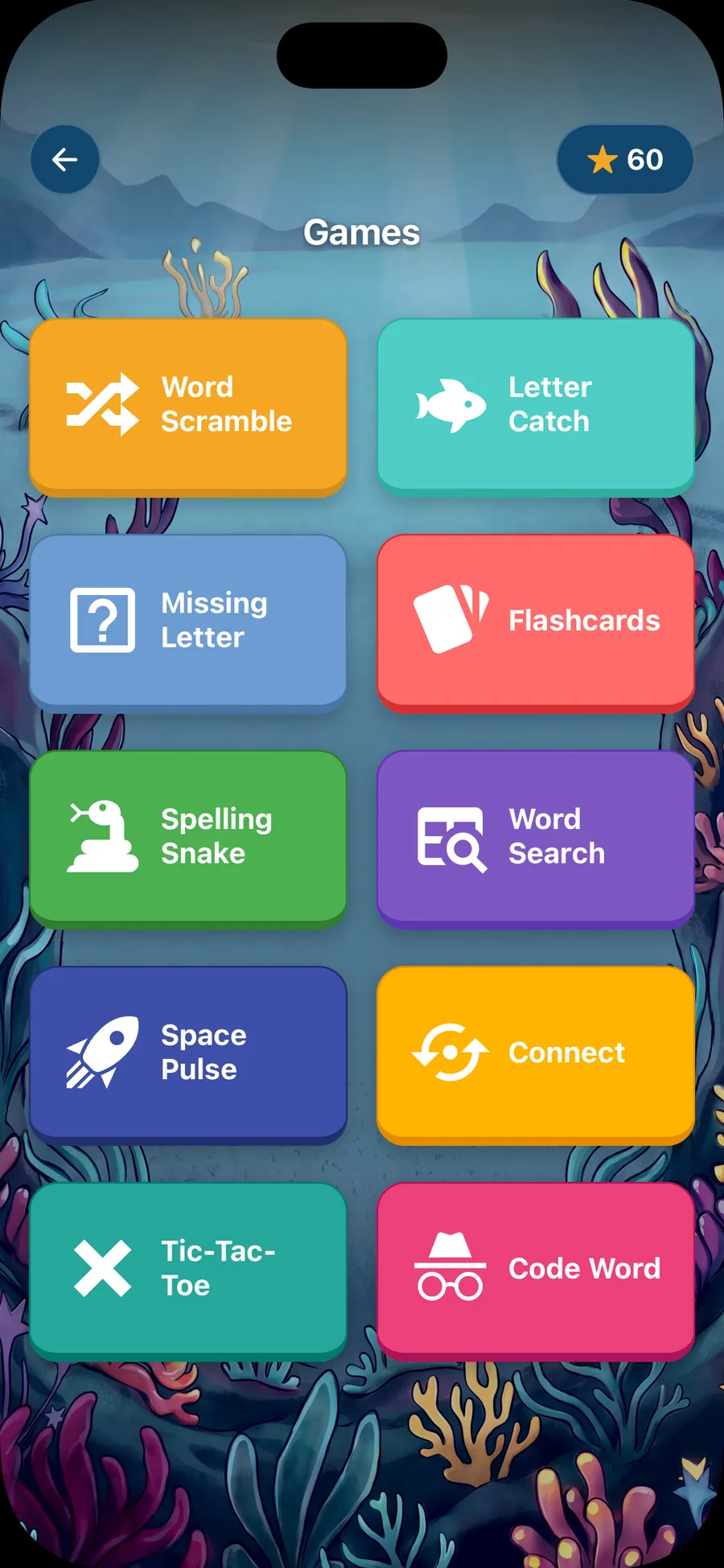
Each game uses your words and reads each one aloud, so students can switch games and keep the same words. You choose which games your class sees. When a word sounds like another, such as their and there, the games show a short hint on screen. Read about the games
Scramble
The letters are mixed up. Students tap them back into order after hearing the word.
How it worksMissing letter
One letter has fallen out of the word. Students pick the right one from four tiles.
How it worksFlashcards
Students hear the word, spell it out loud, then flip the card to check.
How it worksFor practice at home
From the class link to the free app
All you do is send the link. Families who want more practice choose Play in the mobile app on the class link, and the list opens in the free Spelling Stream app. The free app covers the first 10 words of a list, so a whole grade-level list fits. How families practice at home
- Open the class list from its link, or snap a photo of it or type it in
- Games, practice tests, and stars and stickers to earn
- Words read in a parent’s own recorded voice, or the built-in voice
- No ads, no account, and it works offline
The free app covers one word list, with the first 10 words in games and tests. Spelling Stream Pro covers up to 100 lists of 50 words each. More about the app at spellingstream.com
Privacy
Nothing collected from students
Students don’t sign in and don’t type anything about themselves. The games keep no names, no class codes and no scores, and nothing is sent back to the teacher. Read the privacy policy
Questions
Questions about the grade-level lists
Are these spelling lists free?
Yes. The lists, the class link and the student games are free. Spelling Stream for Teachers has no paid tier, no trial and no ads. The separate Spelling Stream app for families has a paid plan, which teachers and students never need.
Do students need an account?
No. Students open the class link in any web browser and play. There are no student accounts, logins or class codes, and nothing about students is collected.
How do the lists relate to the Common Core?
Each list is built on a spelling pattern in the Common Core State Standards for English Language Arts for its grade, and each grade page quotes the standards it uses. Many states publish their own standards, so check the lists against your state’s.
Which grade should I start with?
Start with your students’ grade, then move up or down by pattern. A 3rd grade group still mixing up oa and ow can use that list from the 2nd grade page. Each group can have its own class list and link.
Can I use my own words instead?
Yes. Type or paste any words into a class list, up to 40 a list, or start from a grade-level list and change it. You can keep up to 25 lists.
Make your first list in a minute
Free for teachers. Sign in with Google or an email and password, start from a grade-level list or type your own words, and share one link.