The short answer
Silent e words have a vowel, a consonant and a final e, and the first vowel says its name: cape, kite, hope, cube. Teachers also call the pattern magic e, bossy e, CVCe or VCe. Teach it in 1st grade by adding an e to short words (cap becomes cape), then a_e and i_e, then o_e and u_e, with the rare e_e last.
Add an e to cap and you get cape. The e makes no sound of its own, but the a now says its name. That is the silent e pattern, and it gives students a reliable way to spell long a, long i, long o and long u in short words. This guide covers the names teachers use for it, an order to teach the five vowels, the words that look like the pattern but aren’t, and four lists to play.
Silent e, magic e, bossy e or CVCe
All four names describe the same spelling. The glossary of the IES practice guide on foundational reading skills defines it as “a sound–spelling pattern with a final silent e that changes the pronunciation of the vowel that precedes it.” Reading Universe’s overview of magic e lists the other names in use, among them silent e, sneaky e, bossy e, final e and VCe.
- Silent e and magic e describe the final e: it is silent, and it changes the vowel before it.
- Bossy e is the classroom version: the e tells the vowel to say its name.
- VCe and CVCe describe the letters. VCe is vowel, consonant, e, as in ate. CVCe adds a consonant in front, as in cape. Teachers sometimes write CCVCe for words such as crane.
Some phonics programs call the vowel and the e together a split digraph: two letters that spell one sound, with a consonant between them. The words are the same either way, so use the name your school’s program uses and connect it to the others when students bring them in from home.
A simple way to mark the pattern, from the Reading Universe overview: draw an arch from the e back over the consonant to the vowel, and put a short line over the vowel to show it’s long. Drop the marks once students can read the words without them.
The order to teach silent e
The Common Core standards put final e in 1st grade (RF.1.3c), and the IES guide places long vowels with silent e after consonant blends and digraphs and before vowel teams such as ea. Within the pattern, this guide uses this order:
- Short and long pairs: add an e and hear the vowel change
- a_e and i_e
- o_e and u_e, including the two sounds of u_e
- e_e, and silent e in two-syllable words, in 2nd grade
1. Short and long pairs
Pairs show the whole idea at once. Write cap, read it, add an e, and read cape. The IES guide describes the same kind of word building, such as making cane after can. Students already know the short word, so all they have to notice is what one letter does to the vowel. Do a few pairs aloud before playing the list, and have students say which word in each pair has the long vowel.
1st grade: short to long, add an e
Five pairs. Read the short word, add an e, and listen for the vowel to say its name. Made sounds like maid, so the games show a short hint for it.
- can
- cane
- dim
- dime
- cod
- code
- cub
- cube
- mad
- made
2. a_e and i_e
Several high-frequency words use these two, such as made, like and five. Reading Universe notes that once students know the pattern, they can sound these words out instead of memorizing them. Teach a_e and i_e a week apart, then mix them so students listen for the vowel before they choose. The k sound gives a useful check here: after a long vowel it’s spelled k with the e, so it’s rake, not rack, and like, not lick. Reading Universe points out this link between silent e and the ck rule.
Base sounds like bass, so every game shows a short hint on screen, “bottom part”, to say which word is meant. How the sound-alike hints work
1st grade: a_e and i_e
Draw an arch from the e back over the consonant to the vowel. Base sounds like bass, so the games show a short hint for it.
- base
- rake
- crane
- cage
- wide
- dive
- nine
- pipe
- wipe
- line
3. o_e and u_e
o_e behaves the way a_e does: hope, cone, stove. u_e has two sounds, which Reading Universe shows with cube and tune. In cute and huge it says “you”, and in flute and rude it says “oo”. Both are spelled the same way, so name both sounds when you introduce it and have students sort the words by what they hear.
1st grade: o_e and u_e
u_e has two sounds: “you” in cute and huge, and “oo” in flute and rude. Sort the u_e words by what you hear.
- hope
- cone
- stove
- drove
- chose
- dune
- cute
- huge
- flute
- rude
4. e_e, and longer words
Reading Universe notes that e_e isn’t very common and is often taught last. Start with these, a high-frequency word, then compete, extreme and concrete, which show it in longer words.
2nd grade is also the time for silent e in two-syllable words (RF.2.3c). In longer words, the silent e syllable almost always comes at the end, as in invite and include. Compound words make good practice: clap pan-cake or bed-time, spell one part at a time, and find the silent e in the second part.
2nd grade: e_e, and silent e in two-syllable words
e_e is the rare one. In the longer words, clap the syllables: the silent e syllable comes last.
- these
- compete
- extreme
- concrete
- pancake
- sunrise
- bedtime
- invite
- include
- escape
Common exceptions
- have and give. The e is silent but the vowel stays short. English words almost never end in v, so these take an e anyway.
- come, some and done. The o_e spells a short u sound. Teach them as heart words, with the regular letters sounded out.
- were, where and there. They end in e but don’t follow the pattern. Teach them as heart words too.
- house and mouse. The e is silent, but the vowel sound comes from ou, not from the e.
- live. It can rhyme with give or with five, depending on the meaning, so keep it off a list until students know both.
A week of silent e with a class link
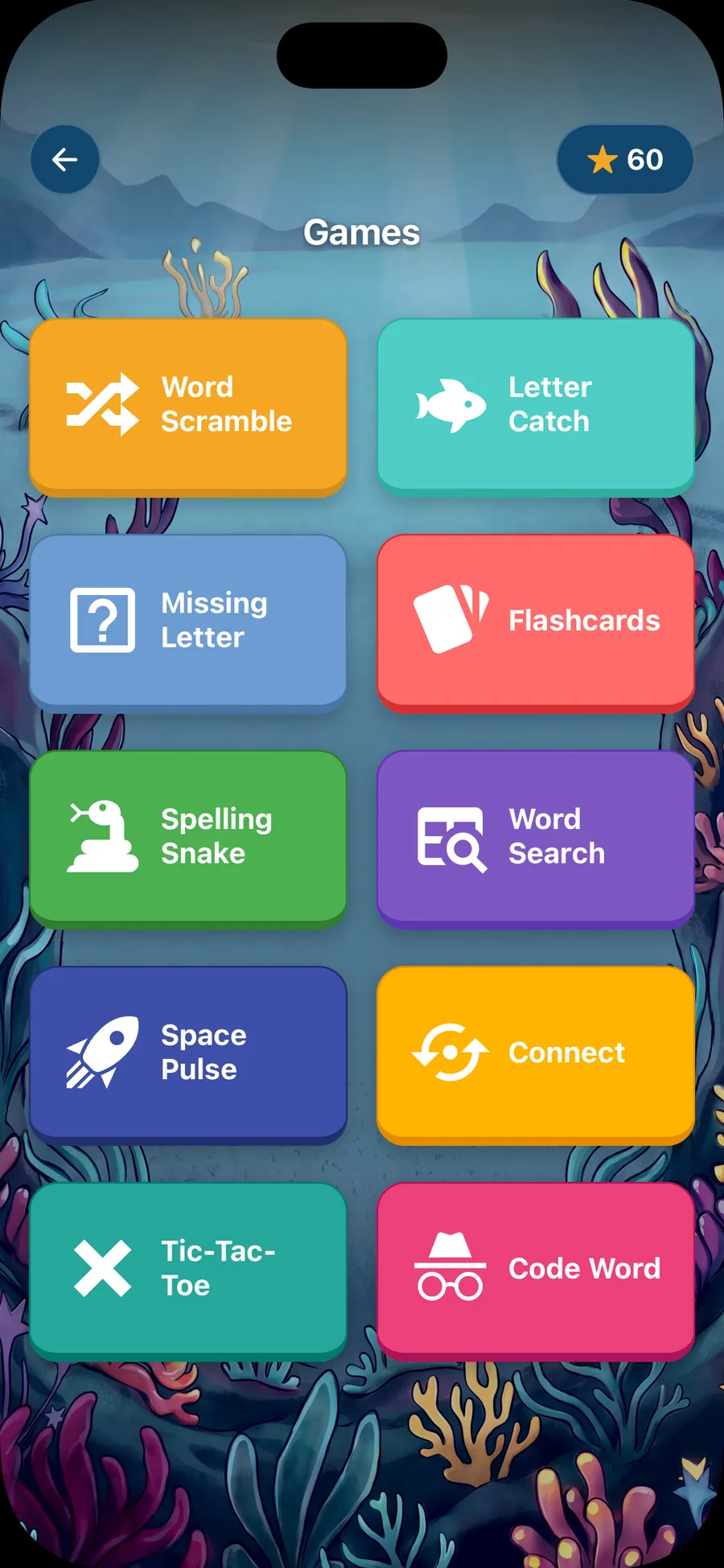
Spelling Stream for Teachers turns a list into games your class plays in any web browser, with every word read aloud in US English. It’s free, with no student logins and no ads. Take a set from this page or type your own words, then share one link.
- Monday. Play the list together. For each word, tap the sounds and draw the arch from the e to the vowel. Share the link by email, Google Classroom or a QR code.
- Midweek. In Scramble, students rebuild each word, so the e has to go last. When Missing letter takes out the e, students have to hear the long vowel and remember the letter that makes it. Flashcards asks them to spell each word out loud before they flip the card. At home, families can open the class list in the free Spelling Stream app and keep practicing on their own device.
- Thursday. Sort the week’s words into a_e, i_e, o_e and u_e columns, and add one word of your own to each.
- Friday. Give the test the way you usually do. Next week, edit the list and the same link opens the new words.
If some students are still on short vowels, give that group the pairs list and the rest of the class a_e and i_e. Each list gets its own link, and you can keep up to 25 lists. The spelling homework ideas fit any of these lists.
Silent e in the Common Core standards
The Common Core State Standards for English Language Arts bring in final e in 1st grade and extend long vowels to two-syllable words in 2nd grade:
- RF.1.3c: “Know final -e and common vowel team conventions for representing long vowel sounds.”
- RF.2.3a: “Distinguish long and short vowels when reading regularly spelled one-syllable words.” The pairs list is built for this.
- RF.2.3c: “Decode regularly spelled two-syllable words with long vowels.”
For more lists by grade, see the 1st grade spelling words and the 2nd grade spelling words, or spelling words for every grade. Many states publish their own English language arts standards, so check any order against your state’s standards and your school’s scope and sequence.
Sources: Common Core State Standards, Reading: Foundational Skills, Grade 1 and Reading: Foundational Skills, Grade 2; IES What Works Clearinghouse, Foundational Skills to Support Reading for Understanding in Kindergarten Through 3rd Grade(2016); Reading Universe, Overview of Magic ‘e’; Reading Rockets, A New Model for Teaching High-Frequency Words.
Common Core State Standards quoted under the public license. © Copyright 2010. National Governors Association Center for Best Practices and Council of Chief State School Officers. All rights reserved.
Questions
What is the difference between silent e, magic e and CVCe?
They name the same pattern. Silent e, magic e and bossy e describe the final e, which makes the vowel before it say its name. CVCe and VCe describe the letters: consonant, vowel, consonant, e. Some programs call the vowel and the e together a split digraph.
Which silent e words should I teach first?
Start with short and long pairs such as cap and cape, so students hear the e change the vowel. Then teach a_e and i_e, then o_e and u_e. Leave e_e for last, since few common words use it.
Why do have and give end in e if the vowel is short?
Their e is silent but doesn’t change the vowel. English words almost never end in v, so have and give take an e anyway. Teach them as heart words: sound out the regular letters and learn the e by heart.
What grade learns silent e?
1st grade. The Common Core standard RF.1.3c asks students to know final -e conventions for long vowel sounds. In 2nd grade, RF.2.3c moves on to two-syllable words with long vowels, such as sunrise and invite.