
Teacher guide

Homophones on your spelling list: how the hints work

The short answer

When a word on your list sounds like another word, such as stationary and stationery or there, their and they’re, every game shows a short hint on screen under the Hear it button, like “not moving” or “belongs to them”. Students hear the word and read the hint, so they know which spelling you mean. In your list, those words get a ≈ mark you can point at or tap to read the hint. The hints are built in and there is nothing to set up.

Every game in Spelling Stream for Teachers reads each word aloud. That works until two words sound the same. A student who hears “stationary” has a coin flip between two spellings, and a wrong guess gets marked as a spelling mistake.

What students see

For a sound-alike word, the hint sits right under the Hear it button. It’s there from the start of the round, so students read it before they answer.
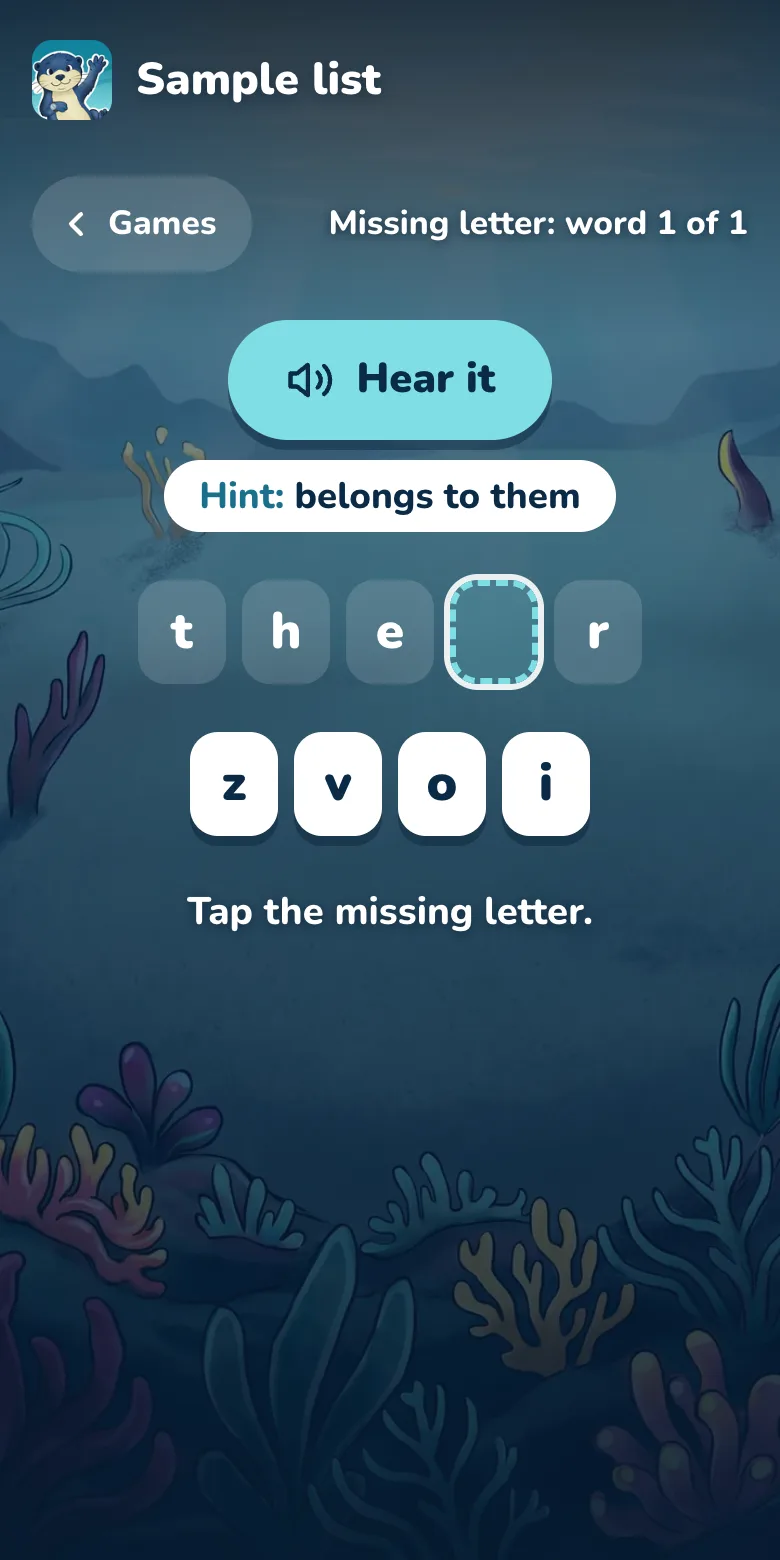
Missing letter on a phone, with the word t h e blank r and the hint 'belongs to them' under the Hear it button
Missing letter with “their”. The missing letter could be e or i, and only the hint tells the student which word they heard.

Each hint is a few plain words a young reader can manage. Some examples:

A hint never uses the word itself or the word it sounds like, so the spelling stays the student’s job. You’ll see it in Scramble, Missing letter and Flashcards.

What you see in your list

In the list editor, each word that sounds like another gets an orange border and a ≈ mark. Point at the mark, or tap it on a tablet or phone, to read the hint your students will see. A note under the words explains the mark whenever your list has one.
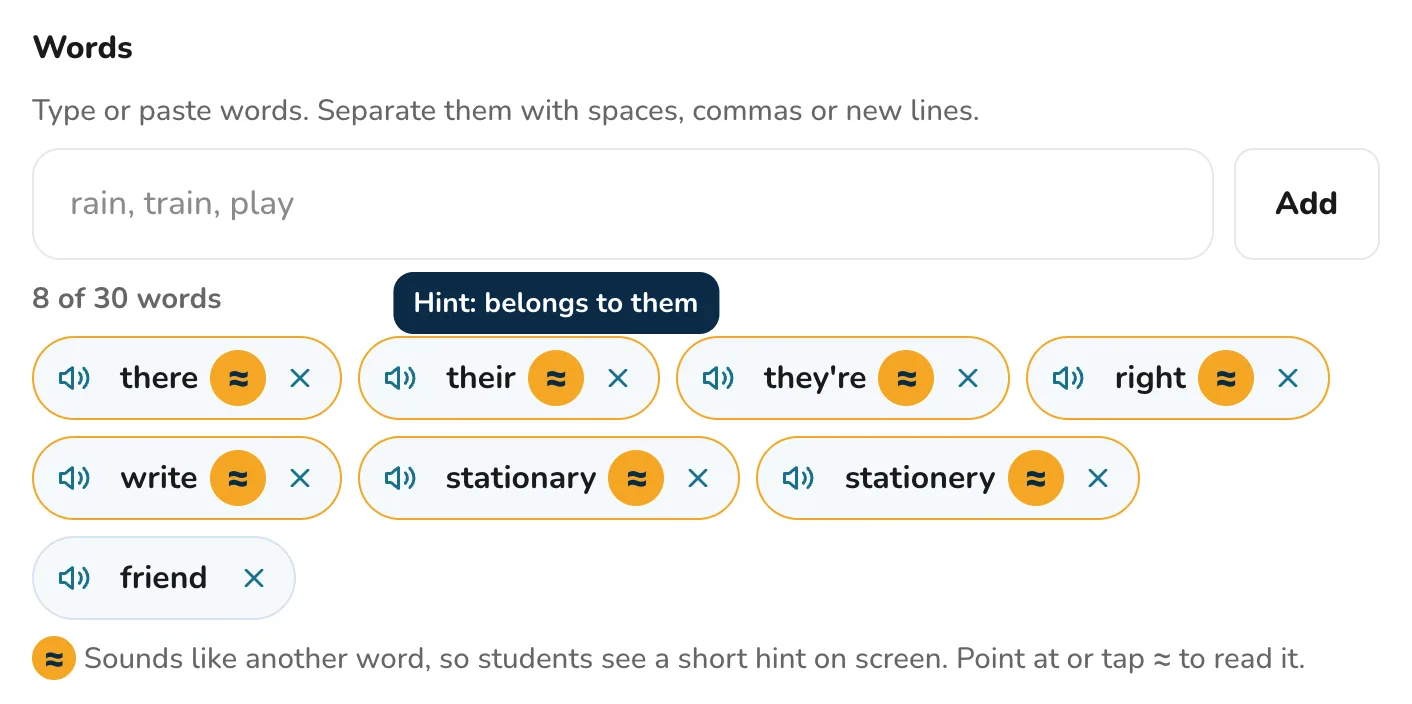
The list editor with there, their, they're, right, write, stationary and stationery each marked ≈, and the hint 'belongs to them' shown over their
A homophone week in the editor. Pointing at the mark on “their” shows its hint.

There’s no setting for it. Type or paste your list as usual and the marks show up as you add words. Plenty of everyday words have a sound-alike (rain, one, for), so expect a mark or two on ordinary weeks as well.

Homophone weeks

With hints on screen, both words of a pair can go on the same list. Go over the meanings on Monday before anyone plays, and the hint becomes a reminder of something students already know. On Friday, give each homophone as word, sentence, word, the way you did all week.

For pairs that show up on most elementary lists and memory hooks that help students keep them apart, see homophones on a spelling test. For the rest of the week, the weekly spelling routine has a day-by-day plan.

At home, the Spelling Stream mobile app goes a step further. With Enhanced Voice, part of the app’s Pro plan, it says a homophone, uses it in a short sentence, then says it again. The browser version your class uses is free and shows the hint on screen.

Questions

Can I change a hint or write my own?

No. We write them short enough for young readers and check that none of them contains the word or its sound-alike. To see one, point at or tap the ≈ mark next to the word in your list.

Which words get a hint?

About 500 common homophones that sound the same in the list’s accent, such as to, too and two, right and write, ate and eight, and stationary and stationery. Only those words get a hint. The rest of your list plays as usual.

A word sounds like another one but has no mark. What should I do?

Email the pair to support@monthlybalance.com and we’ll look at adding it.

What about students who cannot read the hint yet?

The hint is text, so it helps students who can read a few short words. With kindergarten or early first grade, play the words aloud together first and talk through which meaning each one has, or keep sound-alike pairs on separate weeks.
For practice at home

More practice at home, in the free Spelling Stream app

Families can put this week’s list into the Spelling Stream app on iPhone, iPad or Android and keep practicing on their own device.

  • Open the class list from its link, or snap a photo of it or type it in
  • Games, practice tests, and stars and stickers to earn
  • Words read in a parent’s own recorded voice, or the built-in voice
  • No ads, no account, and it works offline

The free app covers one word list, with the first 10 words in games and tests. Spelling Stream Pro covers up to 100 lists of 50 words each. More about the app at spellingstream.com

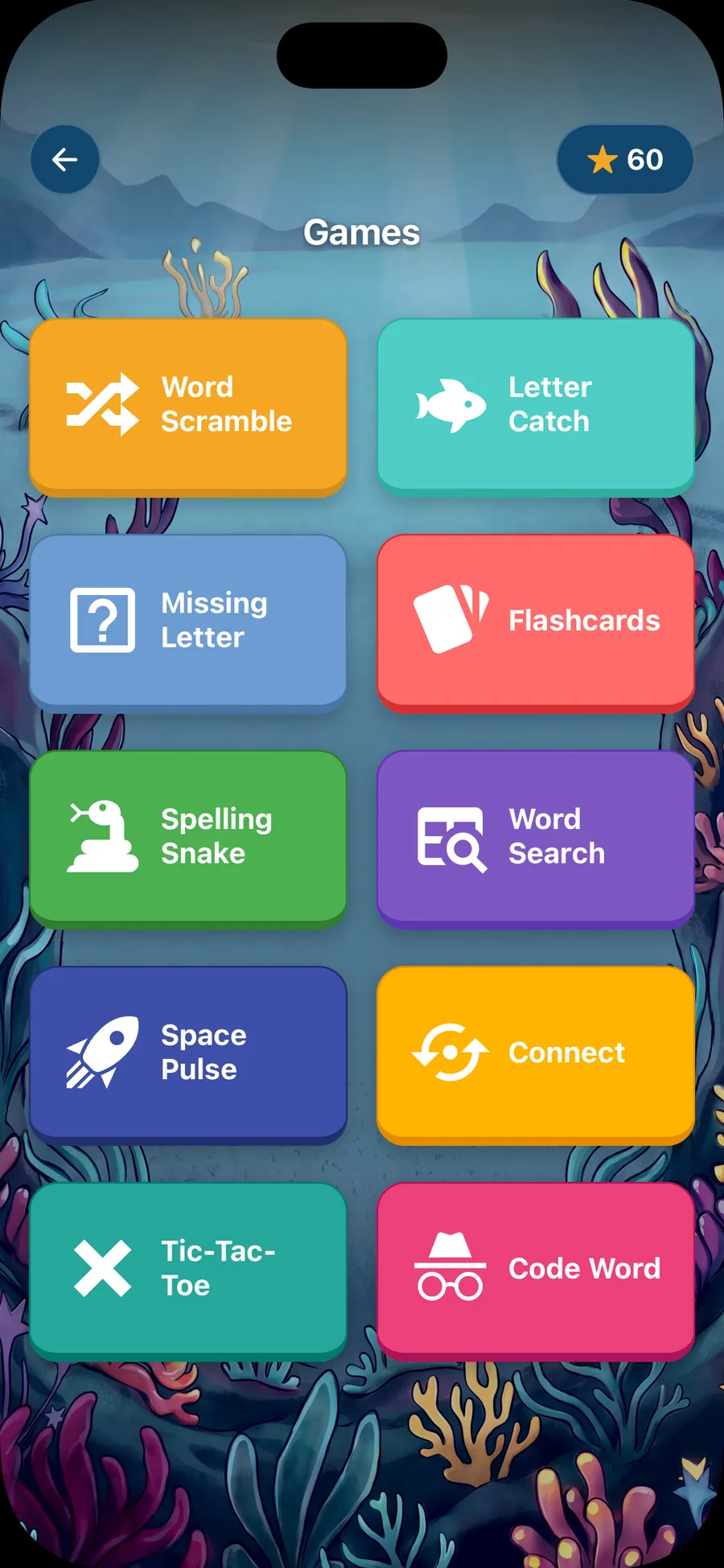
The Spelling Stream app's Games screen

More guides

Keep reading

How to send spelling words home: email template for teachers

A copy-ready email template for sending the weekly spelling list home, plus a short newsletter version, when to send it, and how families can practice at home.

Read the guide

A weekly spelling routine for the classroom, Monday to Friday

A Monday-to-Friday spelling routine for elementary classrooms: a pretest, 10 minutes of practice with games, a Thursday practice test and a Friday test.

Read the guide

Spelling homework ideas that aren’t worksheets

Ten-minute spelling homework families will actually do: games from the class link, saying words aloud, writing from memory and a Thursday practice test.

Read the guide

Spelling centers and early finisher activities

How to run spelling centers with one class link: a device center with a QR code, partner flashcards, letter tiles, a no-device station and early finisher work.

Read the guide

Long a words: ai, ay, a_e and the less common spellings

Long a words for 1st and 2nd grade: when to use ai, ay or a_e, the eigh, ey and ea words, the exceptions, and long a word lists to play with your class.

Read the guide

Consonant digraph words: sh, ch, th, wh, ck, ng and ph

Digraph words for kindergarten to 2nd grade: what a consonant digraph is, the order to teach sh, ch, th, wh, ck, ng and ph, when to use tch, and lists to play.

Read the guide

Silent e words: a_e, i_e, o_e, u_e and e_e

Silent e words for 1st and 2nd grade: what magic e, bossy e and CVCe mean, the order to teach a_e, i_e, o_e, u_e and e_e, the exceptions, and lists to play.

Read the guide

Sight words and heart words for kindergarten to 2nd grade

Sight words for kindergarten to 2nd grade: high-frequency vs irregular words, the heart word method, what research says on word shapes, and lists to play.

Read the guide

Dolch sight words: every level, with sets to play

The full Dolch sight words list: pre-primer, primer, first, second and third grade words and the 95 nouns, with where it came from and how to teach it.

Read the guide

Adding -ed and -ing: suffix rules for kids, with word lists

Suffix rules for adding -ed and -ing in US spelling: just add, drop the e, the doubling rule, y to i, the single l in traveled, and the three sounds of -ed.

Read the guide

Plural spelling rules: s or es, ies, ves and irregular plural nouns

Plural spelling rules for kindergarten to 5th grade: s or es, y to ies, f to ves, o words and irregular plural nouns, with a check for each and lists to play.

Read the guide

Common prefixes: meanings, the spelling rule and word lists by grade

Common prefixes for 2nd to 5th grade, from un-, re- and dis- to in-, im-, il- and ir-: what each means, the spelling rule, the order to teach and word lists.

Read the guide

Tion and sion words: how to pick the right ending

Words ending in -tion, -sion, -ssion and -cian, sorted by rule: the base-word check, the zh sound, the order to teach, the exceptions and lists to play.

Read the guide

Silent letter words: patterns, word histories and lists by grade

Silent letter words for 2nd to 5th grade, grouped by letter: kn, wr, gn, mb, bt, st, sc, gh, h and l, with a partner word for each and lists to play.

Read the guide

Greek and Latin roots: meanings, examples and word lists

Common Greek and Latin roots for 4th and 5th grade, with a meaning and two examples each, why ph spells f, the order to teach and root word lists to play.

Read the guide

Make your first list in a minute

Free for teachers. Sign in with Google or an email and password, type your words, and share the link.