The short answer
Introduce the list and give a short pretest on Monday, practice for about 10 minutes a day from Tuesday to Thursday, give a practice test on Thursday, and test on Friday. Words a student misses on Friday can carry over into the next week. Short daily practice with spelling games covers the middle of the week without a new worksheet each day.
A spelling week goes smoothly when every day has a job and none of them takes long. Use the whole routine below, or borrow the parts that fit your schedule.
Monday: introduce the list and pretest
Read the list aloud, talk through the pattern if there is one (long a spelled ai and ay, say, or words ending in -tion), and point out any word that breaks the rule. Five minutes is plenty.
Then give a short pretest. It looks like the Friday test, but nobody gets graded. You're finding out which words each student already knows. A student who spells 9 out of 10 correctly on Monday doesn't need to spend the week on all 10. They can focus on the one they missed, or take on a few challenge words.
Monday is also the day to send the list home. The email template for families covers what to include.
Tuesday to Thursday: 10 minutes of practice
The middle of the week is for practice, and it's where a routine can turn into a stack of worksheets. Short practice on the screen is an easy swap. Students can do it at a center, as a warm-up, or while you work with a small group.
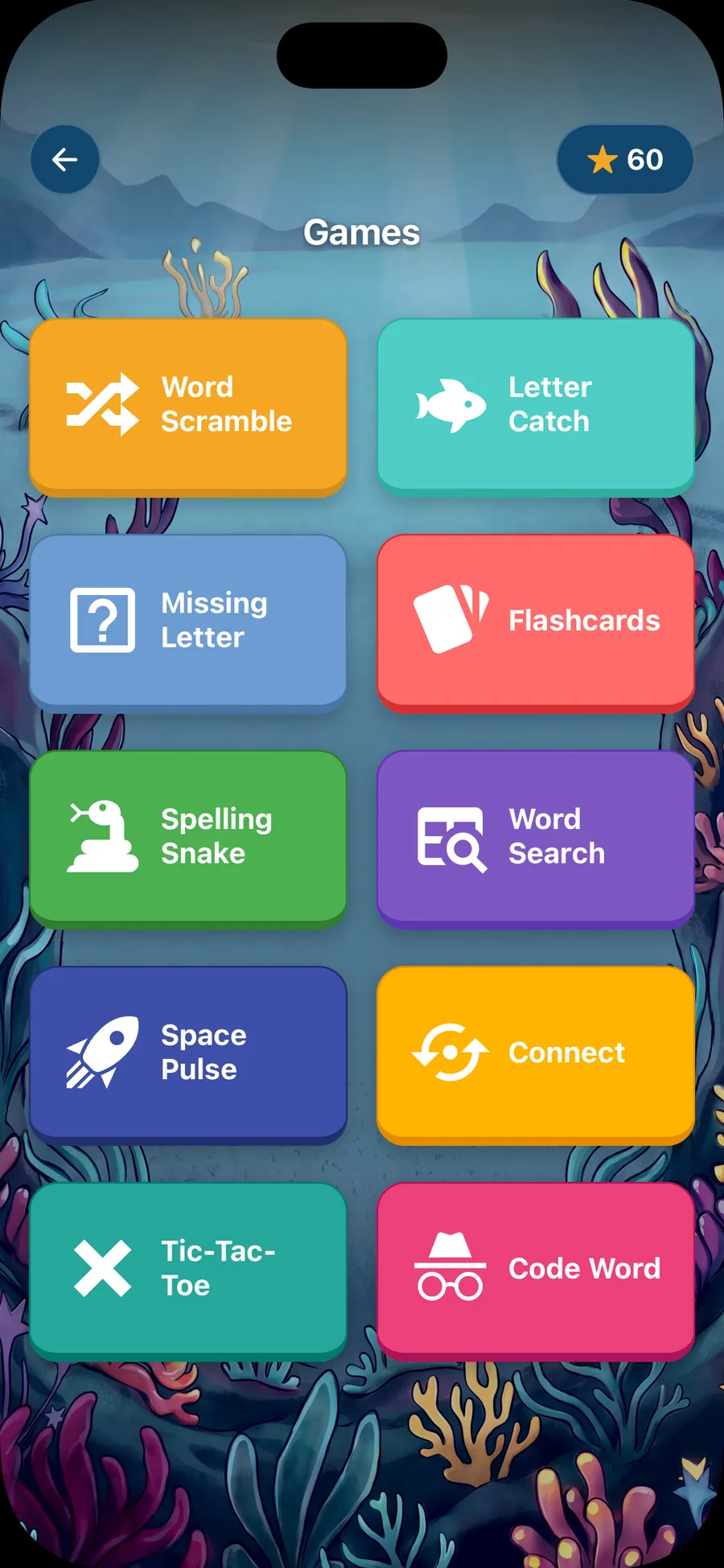
Spelling Stream for Teachers has three games, and all of them use your list. Each game goes through every word on the list once, in a random order, and reads each word aloud in the voice you chose for the list. A simple way to spread them across the week:
- Tuesday: Missing letter. One letter is gone, and the student picks it from four tiles. It draws attention to the tricky spots, like the vowel in the middle of a word. Picking one letter is the easiest of the three, so it comes first.
- Wednesday: Scramble. The letters of the word come jumbled, and the student taps them into the right order. It gets students looking at letter order without having to produce the whole word from memory yet.
- Thursday: Flashcards. The student hears the word, spells it out loud, then flips the card to check. Of the three, it's the closest to a real test, so it fits the day before one.
One list covers all three games, so there's nothing to set up after Monday. Students open the class link in any web browser, with no accounts or logins, and pick the day's game. If students share devices, the same link works on every one of them.
To get the link, make a free list: paste the words (spaces, commas or new lines all work), play each one to check how it sounds, and save. You can share it as a link, a QR code on the board, or with the Share to Google Classroom button. How it works has the details.
Thursday: a practice test
After the game, give a practice test on paper. Read each word, use it in a sentence, and have students write it. Mark it together or collect it, whichever is faster for your class.
The practice test shows you and each student which words still need work, with one day left to do something about it. Students can take their practice test home and go over the missed words that night.
Taking the practice test is practice too. A 2013 review of 10 common study techniques rated two of them the most useful for learners of different ages: practice tests, and practice spread over several days instead of crammed into one. This routine uses both.
Friday: the test
Give the test the same way as the pretest and the practice test, so the format holds no surprises. Same order of steps, same kind of sheet. Read each word, say it in a sentence, and read the word again.
If a word has a homophone (there and their, for instance), the sentence matters more than usual. Say it the same way you did all week.
What to do with missed words
Every class has words that don't stick by Friday. Two habits keep them from piling up.
- Carry a few forward. Add two or three missed words to that student's next list. More than that and the new list gets too long to learn in a week.
- Keep a review list. Collect the words the whole class missed and bring them back as a short review list every few weeks. You can save it as its own list in Spelling Stream for Teachers and share its link when you need it.
You can edit a list any time and the link stays the same. If you'd rather keep the original list as it was, make a copy and edit the copy.
Adjusting the routine by grade
Kindergarten and 1st grade
Keep lists short, often five to eight words, and keep sessions short too. Plan on five to eight minutes of practice. Play the words aloud together before anyone starts a game. Scramble and Missing letter suit this age well because students pick from letters instead of writing the whole word. Hearing each word read aloud matters most here, since many students can't read every word on the list yet.
Grades 2 and 3
A list of 10 to 15 words fits the full Monday-to-Friday routine at this level. Students can run the games on their own at a center. Flashcards starts to pull its weight here, because saying the spelling out loud is good practice for writing it on Friday.
Grades 4 to 6
Lists get longer and the words get harder, so the Monday pretest earns more of its time. Students who already know most of the list can take a handful of challenge words instead. Older students can do the games as homework or as an early finisher activity. Lists in Spelling Stream for Teachers hold up to 40 words.
Keeping families in the loop
The routine works better when practice happens at home too, even a few minutes a night. The class link works at home the same way it works at school, in any web browser. Families who want more can add the list to the free Spelling Stream app, which has more games, practice tests and rewards like stars and stickers. The free version covers one list with the first 10 words. The practice at home page has more on the app.
For ways to cut down on spelling worksheets, see spelling homework ideas and spelling centers.
Questions
How long should daily spelling practice take in class?
Plan on about 10 minutes on Tuesday, Wednesday and Thursday. Keep kindergarten and first grade to five to eight minutes. Older students can go a little longer.
Is a Monday pretest worth the time?
It takes about as long as the Friday test and shows which words each student already knows. Students who get most of the list right on Monday can spend the week on the few they missed or on extra words.
What should I do with words a student misses on Friday?
Carry two or three of them into that student's list for the next week, or keep a short review list that comes back every few weeks. Bringing back every missed word makes the next list too long.
Can students practice on Chromebooks or iPads?
Yes. A Spelling Stream class link opens in any web browser, including Chromebooks, iPads and phones, with no student accounts or logins. Each word is read aloud, so students can practice on their own.