The short answer
A consonant digraph is two consonants that spell one sound, such as the sh in shell or the ch in chick. Start with sh, ch and th in short words, then ck and ng after a short vowel, then wh, with ph last. Right after a short vowel at the end of a one-syllable word, the ch sound is spelled tch, as in hatch.
A consonant digraph is two consonants that spell one sound. In shell, the s and h together spell the first sound, and in math, the t and h spell the last one. This guide covers sh, ch, th, wh, ck, ng and ph, plus tch, the three-letter spelling of the ch sound: what they are, an order to teach them in, the words that break the pattern, and four lists your class can play.
What a consonant digraph is
A phoneme is one sound in a spoken word, and a grapheme is the letter or letters that spell it. The glossary of the IES practice guide on foundational reading skills defines a digraph as “a group of two consecutive letters that are read as a single sound (e.g., /ea/ in bread; /ch/ in chat; /ng/ in sing).” Consonant digraphs are the ones made of two consonants.
A digraph isn’t a blend. In a blend such as cr or st, students hear each consonant: crab has four sounds. In a digraph they hear one. The IES guide recommends teaching each sound of a blend and blending them, but says “A digraph makes a single sound and must be taught as a unit.” Counting sounds makes the difference visible: chick has five letters and three sounds, ch, i and ck.
Some sounds take three letters. The tch in hatch spells one sound, and Reading Universe notes that some programs call it a trigraph.
The order to teach them
The IES guide suggests introducing common consonant digraphs such as sh, th and ch after single letters and their sounds. Reading Universe’s overview of consonant digraphs starts with ch, sh and th because many words can be read and spelled with them, and leaves wh and ph for later because few early words use them. It also suggests practicing digraphs in short vowel words first, so students can focus on the new spelling.
- sh, ch and th in short words
- ck and ng at the end, after a short vowel
- wh at the start of a word, and the two sounds of th
- ph, and tch after a short vowel
1. sh, ch and th
Teach the sound before the letters. Say shell slowly, ask for the first sound, then show the two letters that spell it. sh can sit at the start or the end of a short word (shell, rush), and ch most often starts one (chick, chest).
th spells two sounds. In math it’s unvoiced: students feel only air. In that it’s voiced, with a buzz they can feel with a hand on the throat. Reading Universe’s guide to teaching consonant digraphs points teachers to mouth position and that physical feeling to tell the two apart. Both are spelled th, so there’s nothing to choose when writing.
Kindergarten and 1st grade: sh, ch and th
Six short words, each with a sound spelled by two letters. Math has the quiet th, and that has the buzzing one.
- shell
- rush
- chick
- chest
- math
- that
2. ck and ng
ck has a clear rule: in a one-syllable word, when the k sound comes straight after a short vowel, spell it ck. So it’s deck and stuck, but bake, with a long vowel, takes k and an e. Reading Universe’s overview of the ck rule teaches it first among the short vowel spelling rules, because it has very few exceptions.
ng is one nasal sound with no single letter of its own, and it most often comes at the end of a word: hang, rang, lung. Have students say cling slowly and notice that the end is one sound, not n and then g. Reading Universe teaches nk alongside it, as in think and bank.
1st grade: ck and ng after a short vowel
Every word ends in ck or ng straight after a short vowel. Thing has two digraphs: th at the start and ng at the end.
- deck
- track
- stuck
- speck
- flock
- hang
- thing
- cling
- rang
- lung
3. wh, and th both ways
In one-syllable words, wh comes only at the start: when, wheat, while. It begins most question words, so a quick check helps students: if the word asks a question, try wh. How is the everyday question word that doesn’t follow it.
Where sounds like wear, so every game shows a short hint on screen, “what place?”, to say which word is meant. How the sound-alike hints work
This list also brings th back in both sounds. Have students sort the words by feel: quiet th in think, tooth, month and path, buzzing th in those and smooth.
1st grade: wh, and th both ways
wh starts the first four words. The th words split into a quiet group (think, tooth, month, path) and a buzzing group (those, smooth).
- where
- while
- wheat
- whisper
- think
- tooth
- month
- path
- those
- smooth
4. ph, and tch after a short vowel
ph spells the f sound, in words such as phonics, sphere and gopher. Few common early words use it, so ph words are learned a few at a time. 2nd grade is a good fit, and digraph is a useful word for students to spell once they know what one is.
tch asks students to make a choice, which is why it comes after ck. Reading Universe’s overview of the tch rule gives the rule: straight after a short vowel, at the end of a one-syllable word, the ch sound is spelled tch. Everywhere else it’s ch: at the start of a word (chin), after n or l (pinch), and after a vowel team or an r (peach, torch).
2nd grade: ph, and tch after a short vowel
ph spells the f sound in the first four words. In the rest, tch spells the ch sound right after a short vowel.
- phonics
- digraph
- sphere
- gopher
- hatch
- pitch
- switch
- latch
- scratch
- batch
Common exceptions
- rich, much, such and which. Each has a short vowel before the ch sound but no t. Teach them as words to learn by heart.
- ch can say sh or k. It says sh in chef and k in school and echo. Save these for later grades.
- wh can say h. In who, whose and whole, students hear h, not w.
- ck and c in longer words. ck turns up in the middle of words such as jacket and pickle. At the end of a longer word, the k sound is usually c: picnic, panic.
- Letters from two word parts. In anthill and pothole, the t and h belong to different parts of the word, so they aren’t th. The p and h in shepherd work the same way. Say the parts on their own to hear it.
A week of digraph practice with a class link
Spelling Stream for Teachers turns a list into games your class plays in any web browser, with every word read aloud in US English. It’s free, with no student logins and no ads. Take a set from this page or type your own words, then share one link.
- Monday. Play the list together. For each word, tap one finger per sound and underline the digraph. Then share the link by email, Google Classroom or a QR code.
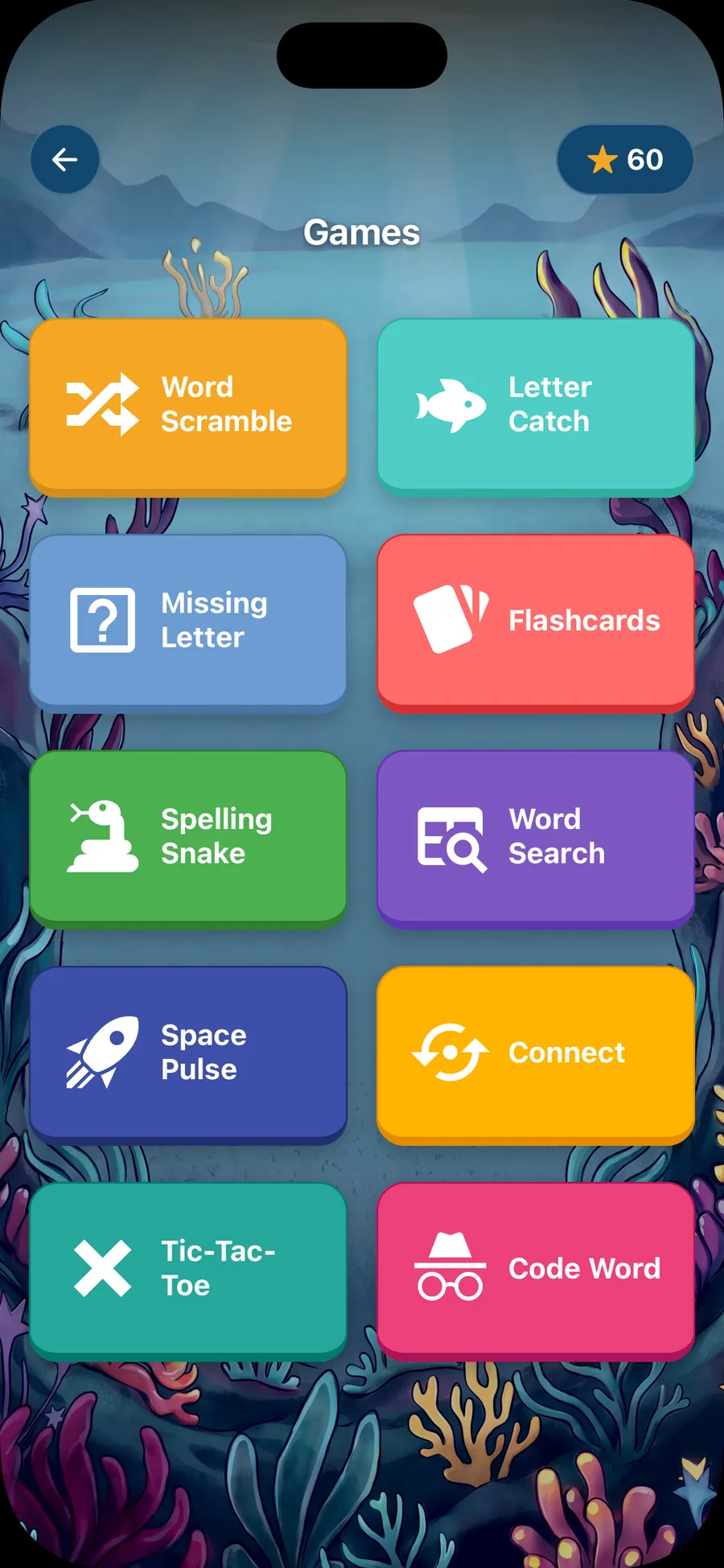
- Midweek. Students play at school or at home. In Scramble, the two letters of a digraph have to end up side by side. Missing letter takes a letter out of each word, and when it’s half of a digraph, students have to remember its partner. Flashcards asks them to spell each word out loud before they flip the card, and the Hear it button replays a word as often as a child needs. Families can open the class list in the free Spelling Stream app and keep practicing on their own device.
- Thursday. Sort the week’s words by digraph on the board, and have students add one word of their own to each group.
- Friday. Give the test the way you usually do. Next week, edit the list and the same link opens the new words.
For kindergarten, keep to the six-word set and play each word together first. Each list gets its own link and QR code, so a group ready for wh can have a different list from a group still on sh and ch.
Digraphs in the Common Core standards
The Common Core State Standards for English Language Arts name consonant digraphs in 1st grade. The kindergarten standards build the single-letter sounds they rest on:
- RF.K.3a: “Demonstrate basic knowledge of one-to-one letter-sound correspondences by producing the primary sound or many of the most frequent sounds for each consonant.”
- L.K.2c: “Write a letter or letters for most consonant and short-vowel sounds (phonemes).”
- RF.1.3a: “Know the spelling-sound correspondences for common consonant digraphs.”
- L.1.2d: “Use conventional spelling for words with common spelling patterns and for frequently occurring irregular words.”
For more lists by grade, see the kindergarten spelling words, the 1st grade spelling words and the 2nd grade spelling words. Many states publish their own English language arts standards, so check any order against your state’s standards and your school’s scope and sequence.
Sources: Common Core State Standards, Reading: Foundational Skills, Kindergarten, Reading: Foundational Skills, Grade 1, Language, Kindergarten and Language, Grade 1; IES What Works Clearinghouse, Foundational Skills to Support Reading for Understanding in Kindergarten Through 3rd Grade(2016); Reading Universe, Overview of Consonant Digraphs, How to Teach Consonant Digraphs, Overview of the ‘-ck’ Spelling Rule and Overview of the ‘-tch’ Spelling Rule.
Common Core State Standards quoted under the public license. © Copyright 2010. National Governors Association Center for Best Practices and Council of Chief State School Officers. All rights reserved.
Questions
What is the difference between a digraph and a blend?
In a digraph, two letters spell one sound, as sh does in shell. In a blend, each letter keeps its own sound, as c and r do in crab. Count the sounds to tell them apart: chick has five letters but only three sounds, ch, i and ck.
When do you use tch instead of ch?
Use tch right after a short vowel at the end of a one-syllable word: hatch, pitch, switch. Use ch at the start of a word (chin), after n or l (pinch), and after a vowel team or an r (peach, torch). Rich, much, such and which are the common exceptions.
Is ck a digraph?
The c and k together spell one sound, the k sound at the end of deck and stuck. Reading Universe calls it a pseudo-digraph, because c and k each spell that sound on their own, and teaches it as a spelling rule of its own: ck comes right after a short vowel.
What grade learns consonant digraphs?
The Common Core standards name common consonant digraphs in 1st grade (RF.1.3a). The first set on this page also suits kindergarten classes that start sh, ch and th earlier, and ph can wait until 2nd grade, since few early words use it.
How do I give one of these lists to my class?
Press Make it a class list under a set. After a free sign-up, the list opens with those words in it, and you can change any word before you share the link. Students open it in any web browser, with no login.