The short answer
Tricky words are common words with a part that doesn’t follow the letter–sound patterns children know, such as the ai in said. High-frequency words are the most common words, and many of them aren’t tricky at all. Heart words is a way to teach the tricky ones: sound out the regular part and learn the odd part by heart. Teach a few a week: say the word, find the tricky part, spell it, and use it in a sentence.
Children need to write some words long before their phonics lessons explain them. said, was, one and they are among the first words young children write, and each has a part that doesn’t sound the way it’s spelt. This guide sorts out the terms high-frequency words, tricky words and heart words, gives a short routine for teaching a tricky word, and has four original lists to play.
High-frequency words, tricky words and heart words
High-frequency words are about how often a word is used. The Australian Curriculum glossary defines them as:
“The most common words used in written English text. Many of these words cannot be decoded using sound–letter correspondence and need to be learnt (e.g. ‘come’, ‘was’, ‘one’).”
Note the word “many”, not “all”. Plenty of high-frequency words are regular: and, it, can, went, this, from. Children can spell those with the letter–sound knowledge they already have, so they don’t need to be memorised as whole words.
Tricky words, also called irregular words, are the ones with a part that doesn’t follow the patterns children know. Two terms help here: a phoneme is one sound in a word, and a grapheme is the letter or letters that spell it. In a tricky word, at least one grapheme spells its phoneme in an unusual way, such as the ai that says short e in said. Some words are tricky only for now. my is tricky until children learn that y can say long i, and then it follows the pattern. Others, such as said and one, stay tricky.
Heart words is a way of teaching tricky words, not a separate kind of word. Children match each sound to its letters, find the part that doesn’t fit, and draw a heart above it: that part is learnt by heart. The rest of the word is sounded out as usual. In said, the s and the d are regular, so only the ai needs a heart. In many tricky words only one or two letters are odd, which leaves children less to memorise than learning the whole word as a shape.
How to teach a tricky word
The same four steps fit any tricky word and take a few minutes.
- Say it. Say the word, then use it in a sentence so children know which word you mean: “I said hello.” Children say the word back.
- Find the tricky part. Tap the sounds together, then write a grapheme for each one. Ask which part doesn’t match what children would expect, and draw a heart above it.
- Spell it. Children say the sounds as they write the word, and name the letters of the heart part aloud: “s, a-i, d”. Then they spell it again from memory, out loud or on a mini whiteboard, and check it.
- Use it in a sentence. Children say a short sentence with the word, then write it. Writing the word inside a sentence is how they’ll use it in their own writing.
Bring each word back over the next few days and again in later weeks, instead of teaching it once and moving on.
Four lists to start from
These lists are our own, grouped by tricky part, and use very common words. Pick one, or take two to four words from it to sit beside a pattern list.
For Foundation, start small. my is tricky only for now; of, are and do have a vowel that says something unexpected.
Foundation: first tricky words
Short words with one odd part each. Say each one in a sentence before you play.
- of
- are
- my
- do
- put
- all
For Year 1, ten very common words. said and was are good first heart words, because each has only one or two odd letters.
Year 1: tricky words children write every week
Some of these sound like other words, such as two and too. The games show a short hint on screen, such as “the number 2”, so students know which one is meant.
- said
- was
- one
- two
- some
- there
- were
- does
- your
- want
could, would and should are easier together than apart: learn ould once and you have three words. people, friend and because are longer, so mark the heart part and sound out the rest.
Years 1 and 2: could, would, should and more
could, would and should share their tricky part, ould, so teach them together.
- could
- would
- should
- people
- friend
- because
- again
- who
- water
- once
By Year 2, children can see that some tricky parts repeat. The o in come says the same sound in mother, love and nothing, and the a in any says the same sound in many. A repeated tricky part becomes a small pattern children can use, and anyone joins two tricky words they already know.
Common exceptions: words that look tricky but aren’t
- Regular high-frequency words. and, it, went, with and just follow the patterns. Teach them with phonics, not as words to memorise.
- Tricky for now. In he, she, we, go and no, the vowel at the end of the word says its name. Once children learn that pattern, these words are regular.
- Regular once a later pattern arrives. they uses ey for long a, as in grey and obey. school uses ch for the k sound, which the Year 3 spelling words cover.
- Words that sound like other words. two, there and your each sound like other words, so the spelling depends on the meaning as well as the sounds.
Tricky words in your week, with a class link
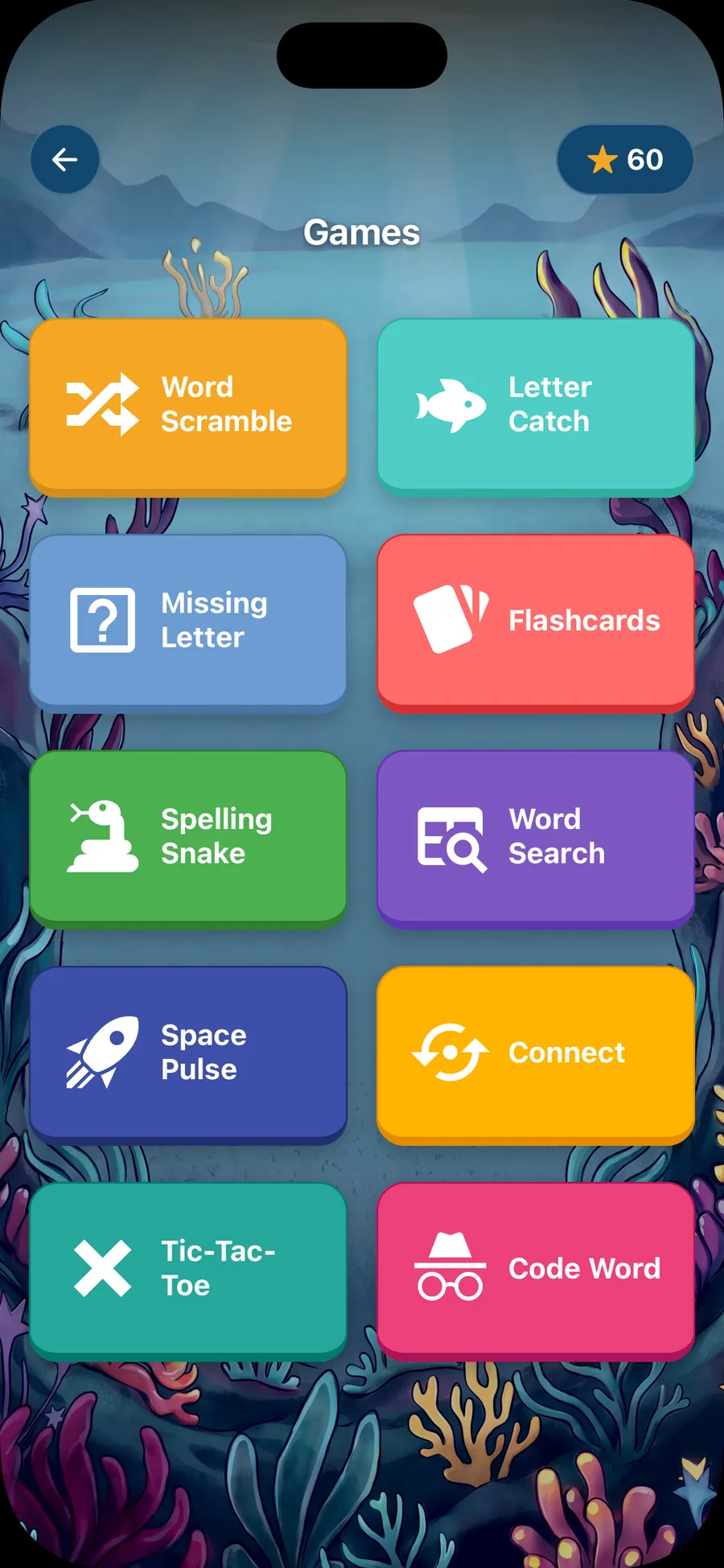
Spelling Stream for Teachers turns a list into games your class plays in any web browser, with every word read aloud in Australian English. It’s free, with no student logins and no ads.
- Add them to the pattern list. Put two to four tricky words at the end of the week’s list, so students meet them in every game. A list holds up to 40 words.
- Use Flashcards for spelling from memory. In Flashcards, students hear the word, spell it out loud, then flip the card to check. That is step 3 of the routine.
- Use Missing letter for the heart part. Missing letter takes a letter out of each word, and when it’s a letter in the heart part, students have to remember it. Older classes can set it to hide up to 3 letters.
- Keep a term list. Make a second list for every tricky word the class has learnt this term, and add to it each week. Edit the words and the link stays the same, so families keep using one link.
When a word on a list sounds like another word, such as two and too, each game shows a short hint on screen, so students know which spelling is meant. How the sound-alike hints work · How the class link works in Australian classrooms
Where tricky words sit in the Australian Curriculum
The Australian Curriculum v9.0 English doesn’t use the terms tricky words or heart words. It talks about high-frequency words from Foundation, and in Year 2 about words whose spelling isn’t predictable from their sounds:
- AC9EFLY14: “read and write some high-frequency words and other familiar words”.
- AC9E1LY14: “read and write an increasing number of high-frequency words”.
- AC9E2LY11: “use knowledge of spelling patterns and morphemes to read and write words whose spelling is not completely predictable from their sounds, including high-frequency words”.
The Foundation spelling words include a list of first high-frequency words, and the Year 1 and Year 2 spelling words have the patterns to teach alongside these lists. New South Wales and Victoria publish their own English syllabus and curriculum, so check any order against your school’s scope and sequence.
Sources: Australian Curriculum v9.0 English glossary, Australian Curriculum v9.0 English, F–6 content.
© Australian Curriculum, Assessment and Reporting Authority (ACARA) 2010 to present, unless otherwise indicated. This material was downloaded from the Australian Curriculum website (Website) (accessed 14 November 2026) and was not modified. The material is licensed under CC BY 4.0. Version updates are tracked in the ‘Curriculum version history’ section on the ‘About the Australian Curriculum’ page of the Australian Curriculum website. ACARA does not endorse any product that uses the Australian Curriculum or make any representations as to the quality of such products. Any product that uses material published on this website should not be taken to be affiliated with ACARA or have the sponsorship or approval of ACARA. It is up to each person to make their own assessment of the product, taking into account matters including, but not limited to, the version number and the degree to which the materials align with the content descriptions and achievement standards (where relevant). Where there is a claim of alignment, it is important to check that the materials align with the content descriptions and achievement standards (endorsed by all education Ministers), not the elaborations (examples provided by ACARA).
Questions
What is the difference between tricky words and high-frequency words?
High-frequency words are the words that turn up most often in writing. Tricky words are words with a part that doesn’t match its sounds, such as the o in come. Many high-frequency words, such as and, it and went, aren’t tricky, and children can spell them with phonics.
What are heart words?
Heart words is a way of teaching tricky words. Children match each sound to its letters, find the part that doesn’t follow the pattern, and mark it with a heart as the part to learn by heart. In said, the s and d are regular and the ai is the heart part.
How many tricky words should I teach each week?
Two to four sit well beside a weekly pattern list in Foundation and Year 1. Bring last week’s words back before adding new ones, and slow down if earlier words aren’t sticking.
Is there an official tricky words list for Australia?
No. The Australian Curriculum v9.0 English content descriptions name high-frequency words from Foundation to Year 2 but don’t list them. The lists on this page are original, grouped by their tricky parts.