The short answer
A prefix goes on the front of a base word and changes the word’s meaning without changing the base word’s spelling: mis and spell make misspell, with both s’s. Teach un- and re- first, in Years 2 and 3, then dis- and mis-, then pre-, sub-, over-, non- and inter- in Years 4 and 5, and leave in-, im-, il- and ir- until Years 5 and 6.
A prefix is a part added to the front of a base word to change its meaning. The Australian Curriculum glossary’s example is un added to happy to make unhappy. Prefixes have a simpler spelling rule than suffixes, because the base word never changes, and each prefix has a meaning students can learn and check. This guide covers common prefixes for Years 2 to 6: what each one means, the spelling rule, the order to teach them, and four word lists to play.
The spelling rule: keep every letter
The rule. Write the prefix, then write the base word exactly as it is. Nothing is dropped and nothing extra is added. Suffixes work differently: the Macquarie Dictionary’s grammar guide notes that adding a suffix may change the spelling of the base word (hope, hoping), and a prefix never does.
The quick check. Split the word where the prefix ends: mis | spell, un | necessary, dis | appear. If the prefix ends with the letter the base word starts with, both letters stay: misspell, unnatural, dissimilar, immobile, illogical, irregular. If it doesn’t, there’s only one: disappear has one s and two p’s, because it is dis and appear. A student who splits the word before writing it can see whether a double letter belongs.
Prefixes and their meanings
| Prefix | Meaning | Examples | Year |
|---|---|---|---|
| un- | not, or undo | unhappy, unzip | 2 and 3 |
| re- | again, or back | replay, return | 2 and 3 |
| dis- | not, or the opposite of | disobey, disconnect | 3 and 4 |
| mis- | wrongly or badly | misspell, miscount | 3 and 4 |
| pre- | before | preview, prehistoric | 4 and 5 |
| over- | too much, or above | overcook, overflow | 4 and 5 |
| non- | not | nonsense, non-fiction | 4 and 5 |
| sub- | under or below | submarine, subway | 5 |
| inter- | between or among | interstate, international | 5 and 6 |
| in-, im-, il-, ir- | not | invisible, impossible, illogical, irregular | 5 and 6 |
The meanings for re-, mis-, pre-, sub- and inter- follow RMIT’s Learning Lab, which also lists in-, im-, il- and ir- with un- as prefixes that make a word negative.
Start with un- and re-
The rule. un- means not when it goes on a describing word (unhappy, uneven) and undo when it goes on an action (unzip, unwrap, unplug). re- means again (replay, repaint, reopen) or back (return).
The quick check. Swap the prefix for its meaning and see if the word still makes sense: unhappy is not happy, and restart is start again. The check also catches words that only look as though they have a prefix. Uncle isn’t “not cle”, and ready isn’t “ady again”, so neither word has one.
Year 2 and 3: un- and re-
Read each word as its meaning: unzip means undo the zip, and replay means play again.
- unzip
- unwrap
- unhappy
- unplug
- uneven
- replay
- reuse
- repaint
- reopen
- restart
The Year 2 spelling words have a list with un- and two suffixes, and the Year 3 spelling words have one for un-, re- and mis-.
Then dis- and mis-
The rule. dis- means not or the opposite of: disobey, disconnect, discolour. mis- means wrongly or badly: mismatch, miscount, misbehave, misjudge.
The quick check. Say the meaning first. Disconnect is the opposite of connect, and miscount is count wrongly. Then split the word to check for a double letter: mis | spell has two s’s, dis | similar has two, and dis | appear has one.
Exceptions. Some words start with the same letters but have no prefix: dish, distance, mist and miss. The meaning check shows it straight away, because none of them means “not” or “wrongly” anything.
Year 3 and 4: dis- and mis-
Split each word into prefix and base word. Misspell and dissimilar have a double s because the base word starts with s. Disappear has one.
- disappear
- disobey
- disconnect
- discolour
- dissimilar
- mismatch
- misbehave
- misjudge
- miscount
- misspell
Next: pre-, sub-, over-, non- and inter-
The rule. These prefixes add a time or a place to the base word. pre- means before (prehistoric, precook). sub- means under or below (submarine, subsoil). over- means too much or above (overcook, overflow). non- means not (nonsense). inter- means between (interstate, international).
The quick check. Put the meaning in front of the base word: before history, under the soil, between states. If the phrase matches what the word means, the prefix and its spelling are right.
Hyphens. Most of these words are written as one word, but a non- word can keep a hyphen. The Australian Curriculum writes non-fiction and non-human, so non-fiction has its hyphen in the set below.
Year 4 and 5: pre-, sub-, over-, non- and inter-
Each prefix adds a when or a where: before, under, too much or above, not, and between.
- prehistoric
- precook
- submarine
- subsoil
- overflow
- overgrown
- nonsense
- non-fiction
- interstate
- international
The Year 5 spelling words have a list for sub- and pre- with different words.
Last: in-, im-, il- and ir-
The rule. All four mean not. They are one prefix that changes its last letter to suit the base word: im- before b, m or p (imbalance, immobile, impossible), il- before l (illogical, illegible), ir- before r (irregular, irresponsible), and in- before most other letters (incorrect, invisible, inactive).
The quick check. Look at the first letter of the base word, then say the word aloud: im- runs straight into the p of possible in a way that in- doesn’t. Because il- and ir- always meet an l or an r, words such as illogical and irregular always have a double letter.
Exceptions. Not every word starting with in means not: inside and include use in to mean in or into. And some words take un- for not instead, such as unable and unreal, so the letter check only chooses between in- and its other forms.
Year 5 and 6: in-, im-, il- and ir-
All four mean not. The first letter of the base word decides which one fits: im- before b, m or p, il- before l, ir- before r.
- incorrect
- invisible
- inactive
- impossible
- impatient
- immobile
- illogical
- illegible
- irregular
- irresponsible
Which prefixes fit which year
The Australian Curriculum names prefixes in each year from Year 2 but lists them only through examples. This order follows those examples where ACARA gives them:
- Year 2: un-. ACARA’s Year 2 example builds cover, covering and uncover from one base word.
- Year 3: re- and mis-, with un-. ACARA’s Year 3 examples are undone, remove and misunderstand. dis- fits here too.
- Year 4: common prefixes. Bring in pre-, over- and non-, and revise dis- and mis- with longer base words. ACARA’s Year 4 example is a word family with tri-: tricycle, tripod and triangle.
- Year 5: sub-, pre- and inter-. ACARA’s Year 5 example links vision, television and revision, a word family that also shows re- on a longer word.
- Year 6: in-, im-, il- and ir-, and prefixes on technical words. ACARA’s Year 6 examples include disappearance, submarine and subterranean.
Practising prefixes with a class link
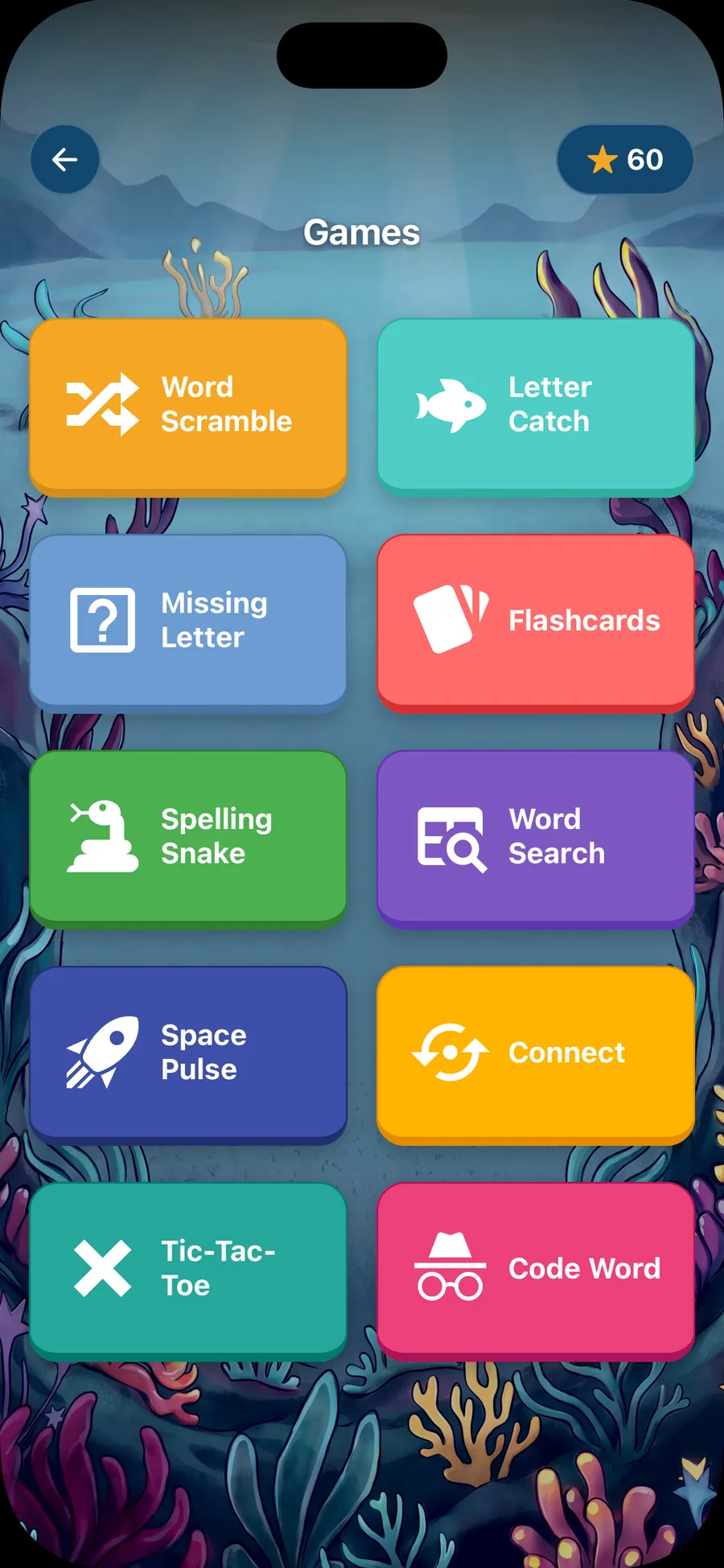
Spelling Stream for Teachers turns a word list into games your class plays in any web browser, with each word read aloud in Australian English. It’s free, with no student logins and no ads. Press Make it a class list under any set above, add your own words, and share one link.
- In Flashcards, have students say the meaning before they spell the word out loud: “dis, not, obey: d-i-s-o-b-e-y”.
- In Scramble, students who find the prefix letters first have a start, and the base word is a word they already know.
- Missing letter can hide up to three letters, and students can type them on the keyboard instead of choosing from tiles. When a gap lands on a double letter, as in mis_pell, the split check tells them the missing letter is the s that starts spell.
A word family list works well once a few prefixes are known: one base word with several prefixes, such as appear, disappear and reappear, or do, undo, redo and overdo. Each list holds up to 40 words and gets its own link. How the class link works in Australian classrooms
Where prefixes sit in the Australian Curriculum
The Australian Curriculum v9.0 English names prefixes in the sub-strand Phonic and word knowledge:
- AC9E2LY12: “build morphemic word families using knowledge of prefixes and suffixes”.
- AC9E3LY10: “understand how to apply knowledge of common base words, prefixes, suffixes and generalisations for adding a suffix to a base word to read and comprehend new multimorphemic words”.
- AC9E4LY10: “understand how to use knowledge of letter patterns, including double letters, spelling generalisations, morphological word families, common prefixes and suffixes, and word origins, to spell more complex words”.
- AC9E5LY09: “build and spell new words from knowledge of known words, base words, prefixes and suffixes, word origins, letter patterns and spelling generalisations”.
- AC9E6LY09: “use knowledge of known words, word origins including some Latin and Greek roots, base words, prefixes, suffixes, letter patterns and spelling generalisations to spell new words including technical words”.
New South Wales and Victoria publish their own English syllabus and curriculum, so check this order against your school’s scope and sequence.
Sources: Australian Curriculum v9.0 English, F–6 content, Australian Curriculum v9.0 English glossary, RMIT Learning Lab, spelling tips, Macquarie Dictionary grammar guide.
© Australian Curriculum, Assessment and Reporting Authority (ACARA) 2010 to present, unless otherwise indicated. This material was downloaded from the Australian Curriculum website (Website) (accessed 14 November 2026) and was not modified. The material is licensed under CC BY 4.0. Version updates are tracked in the ‘Curriculum version history’ section on the ‘About the Australian Curriculum’ page of the Australian Curriculum website. ACARA does not endorse any product that uses the Australian Curriculum or make any representations as to the quality of such products. Any product that uses material published on this website should not be taken to be affiliated with ACARA or have the sponsorship or approval of ACARA. It is up to each person to make their own assessment of the product, taking into account matters including, but not limited to, the version number and the degree to which the materials align with the content descriptions and achievement standards (where relevant). Where there is a claim of alignment, it is important to check that the materials align with the content descriptions and achievement standards (endorsed by all education Ministers), not the elaborations (examples provided by ACARA).
Questions
Why does misspell have two s’s?
Because the prefix and the base word each keep all their letters: mis + spell. A prefix doesn’t change the spelling of the base word, so unnecessary (un + necessary), dissimilar (dis + similar) and irregular (ir + regular) keep their double letters too.
How do I know whether to use in-, im-, il- or ir-?
Look at the first letter of the base word. Use im- before b, m or p (imbalance, immobile, impossible), il- before l (illogical), ir- before r (irregular), and in- before most other letters (incorrect, invisible). This only chooses between in- and its other forms. Some words take un- instead, such as unable and unreal, and those are learnt word by word.
Which prefixes are taught in Year 3 and Year 4?
ACARA’s Year 3 examples are undone, remove and misunderstand, so un-, re- and mis- fit Year 3, and dis- sits well beside them. Year 4 covers common prefixes more widely, which suits pre-, over- and non-. Year 5 brings sub- and pre- in longer words.
Do words with a prefix need a hyphen?
Most don’t: unhappy, rewrite, overflow. A few keep one, and the Australian Curriculum writes non-fiction with a hyphen. A hyphen can also tell two words apart, such as re-cover (cover again) and recover (get better).