The short answer
NAPLAN tests spelling in the first section of the conventions of language test. Most spelling questions play a word in a sentence for students to type, and the rest ask them to correct a misspelt word. ACARA says students aren’t expected to study for NAPLAN, and we found no official word list.
Students in Years 3, 5, 7 and 9 sit NAPLAN, and in 2027 the tests run from 10 to 22 March. Spelling has its own section in the conventions of language test, before grammar and punctuation. Most of its questions play a word aloud in a sentence for students to type. The rest show a misspelt word for them to correct.
Where spelling sits in NAPLAN
The conventions of language test is made up of “a spelling section followed by a grammar and punctuation section.” Once a student moves on to grammar and punctuation, the spelling section locks and they can’t go back to it. ACARA’s assessment framework gives the two sections 45 minutes between them.
The test branches. A student’s answers in one stage decide whether the next stage is harder or easier. The framework sets out the spelling section like this:
- Stage 1: 7 audio dictation questions.
- Stage 2: 9 more audio dictation questions, at a harder or easier level.
- Stage 3: 9 proofreading questions, again harder or easier.
Spelling counts in the writing test as well. One of its marking criteria is spelling, judged on “the accuracy of spelling and the difficulty of the words used.” Year 3 does the writing test on paper. In the spelling section, students type their answers.
The three kinds of spelling question
Audio dictation
Students see a sentence with a gap where the spelling word goes. Through headphones they hear the word and the sentence, then type the word into an answer box. Each sentence is written “to trigger the most likely association of the word”, so it tells students which word is meant. Dictation makes up 55 to 65% of the spelling questions.
Proofreading, with the mistake shown
A sentence shows the spelling word spelt wrongly, and the wrong word is highlighted. Students type the correct spelling. These make up 15 to 25% of the questions.
Proofreading, with the mistake hidden
The sentence has one misspelt word and at least three other words of similar difficulty, all spelt correctly. Students first find the wrong word, then type it correctly. These make up another 15 to 25%.
Students with a hearing impairment do a proofreading version of each dictation question instead. Every spelling answer is marked automatically.
What ACARA says about preparing
ACARA’s NAPLAN FAQs say: “Students are not expected to study for NAPLAN.” ACARA “does not recommend excessive preparation”, and its page on the tests says “The best preparation for NAPLAN is to teach the curriculum.”
The same page says the questions are “based mostly on the literacy and numeracy skills students are expected to have been taught in previous years of schooling.” Year 3 sits the test in March, a few weeks into the school year, so most of what it draws on was taught in Foundation to Year 2. For Year 5, the same goes for Years 3 and 4.
ACARA’s public demonstration site has sample tests for each year level, and ACARA encourages students to try them so the question types and the test screen are familiar before the day.
Dictation in class
A dictation question asks students to hear a word, hold it while they hear it used, and then write it. A class spelling test can take the same shape. Say the word, read a short sentence with the word in it, then say the word again before students write.
The sentence matters most for words that sound the same. Year 3 is when the Australian Curriculum brings in homophones, and students can only choose between tide and tied once they know which one the sentence needs.
Year 3: words that sound the same
Five pairs. Read each word in a sentence before students write it. In the games, a short hint on screen tells them which word is meant.
- new
- knew
- tide
- tied
- past
- passed
- hair
- hare
- dear
- deer
Proofreading in class
Proofreading is a different job from writing a word from memory. The student has to notice that a word looks wrong first, and the second kind of question doesn’t say which word that is. Two short routines practise both:
- Underline one misspelt word in a student’s draft and ask them to fix it. That matches the questions with the mistake shown.
- Write a sentence on the board with one spelling word wrong and three or four others right. Students find the wrong one and correct it. That matches the questions with the mistake hidden.
Use words from this week’s list, so the routine practises the pattern the class is already learning.
Year 3 patterns to keep coming back to
When a suffix goes on, the base word can change. Hug becomes hugged, ride becomes riding and cry becomes cried. The Australian Curriculum puts “generalisations for adding a suffix” in Year 3, and the Year 4 lists come back to the same rules.
Year 3: adding -ed and -ing
Three rules in one list. Double the last letter after a short vowel (hug, hugged), drop the e (ride, riding), and change y to i before -ed (cry, cried).
- hugged
- grabbed
- humming
- tapping
- riding
- hiking
- joking
- raced
- cried
- replied
The Year 3 spelling words page has lists for the year’s other patterns: ch three ways, -dge and -tch, three-letter blends, prefixes and plurals with -es. Because the test leans on earlier years, the Year 2 lists are worth a revisit in Term 1.
Year 5: spell from what you already know
In Year 5 the Australian Curriculum asks students to spell new words from “known words, base words, prefixes and suffixes”. The g in signal is easy to hear, and it is the same g that sits silent in sign. Teach students to ask “what word is inside this one?” when they hear a long word, and again when a word on the page looks wrong.
Year 5: a base word inside a longer word
Find the base word first. Sign is inside signal and signature, which is why the g stays. Please is inside pleasure and pleasant, and heal is inside health.
- signal
- signature
- natural
- pleasure
- pleasant
- health
- knowledge
- creation
- reality
- revision
The Year 5 spelling words page has lists for -able and -ible, -ment and -ness, less common plurals, sub- and pre-, and Greek roots such as tele and graph.
Where the class link fits
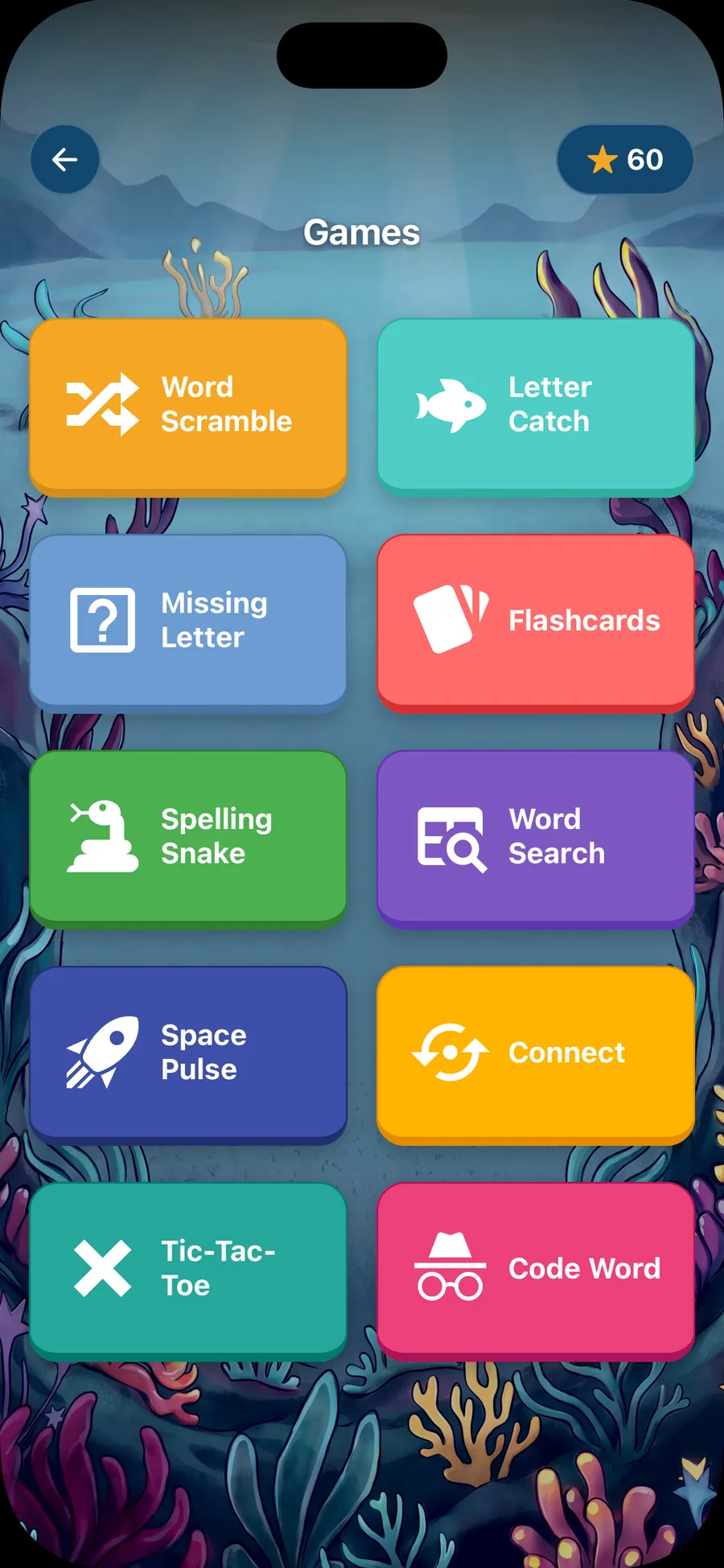
Spelling Stream for Teachers is a free browser tool. You type your class’s spelling words, share one link, and students practise them in games such as Scramble, Missing letter and Flashcards, with each word read aloud in Australian English. There are no student logins, and it keeps no scores.
It isn’t NAPLAN practice, and it doesn’t read a sentence with each word. It gives students more turns at hearing their own list and spelling it, during the week and at home. For the sentence, use the dictation routine above. See how the class link works in Australian classrooms.
Where these patterns come from
ACARA’s framework says spelling questions are “predominantly aligned with the Literacy strand of the Australian Curriculum: English, in particular the Phonic and word knowledge, and Word knowledge sub-strands.” The word sets above follow these Australian Curriculum v9.0 English content descriptions:
- AC9E3LY10: “understand how to apply knowledge of common base words, prefixes, suffixes and generalisations for adding a suffix to a base word to read and comprehend new multimorphemic words”.
- AC9E3LY12: “recognise and know how to write most high-frequency words including some homophones”.
- AC9E5LY09: “build and spell new words from knowledge of known words, base words, prefixes and suffixes, word origins, letter patterns and spelling generalisations”.
New South Wales and Victoria publish their own English syllabus and curriculum, so check the year a pattern falls in against your school’s scope and sequence.
Sources: NAPLAN assessment framework (updated December 2025), NAPLAN key dates, what’s in the NAPLAN tests, NAPLAN online assessment, NAPLAN general FAQs, Australian Curriculum v9.0 English, F–6 content.
Quotes from the NAPLAN assessment framework: © Australian Curriculum, Assessment and Reporting Authority (ACARA) 2025, unless otherwise indicated. This material was downloaded from www.nap.edu.au (accessed 14 November 2026) and was not modified. The material is licensed under CC BY 4.0. ACARA does not endorse any product that uses ACARA’s material or make any representations as to the quality of such products. Any product that uses ACARA’s material should not be taken to be affiliated with ACARA or have the sponsorship or approval of ACARA. It is up to each person to make their own assessment of the product.
© Australian Curriculum, Assessment and Reporting Authority (ACARA) 2010 to present, unless otherwise indicated. This material was downloaded from the Australian Curriculum website (Website) (accessed 14 November 2026) and was not modified. The material is licensed under CC BY 4.0. Version updates are tracked in the ‘Curriculum version history’ section on the ‘About the Australian Curriculum’ page of the Australian Curriculum website. ACARA does not endorse any product that uses the Australian Curriculum or make any representations as to the quality of such products. Any product that uses material published on this website should not be taken to be affiliated with ACARA or have the sponsorship or approval of ACARA. It is up to each person to make their own assessment of the product, taking into account matters including, but not limited to, the version number and the degree to which the materials align with the content descriptions and achievement standards (where relevant). Where there is a claim of alignment, it is important to check that the materials align with the content descriptions and achievement standards (endorsed by all education Ministers), not the elaborations (examples provided by ACARA).
Questions
Is there an official NAPLAN spelling word list?
We couldn’t find one, on nap.edu.au or in ACARA’s NAPLAN assessment framework. The framework says spelling words are selected “to assess a broad range of spelling features in Standard Australian English”, with each year level’s difficulty checked by trialling. ACARA’s advice is that the best preparation is to teach the curriculum.
When is NAPLAN in 2027?
The 2027 test window is 10 to 22 March. Students in Years 3, 5, 7 and 9 sit the tests.
How is spelling tested in NAPLAN?
In the spelling section of the conventions of language test. Students hear a word read in a sentence and type it (audio dictation), correct a highlighted misspelt word, or find the one misspelt word in a sentence and correct it. Spelling is also one of the marking criteria in the writing test.
Should my class study for the NAPLAN spelling questions?
ACARA says “Students are not expected to study for NAPLAN.” It suggests teaching the curriculum, and it encourages students to try the public demonstration site so the question types and the test screen aren’t new on the day.
Is Spelling Stream for Teachers NAPLAN practice?
No. It reads your class’s own spelling words aloud and turns them into games. The NAPLAN dictation questions also play words aloud, but the class link plays each word on its own, without a sentence, and it keeps no scores.