The short answer
A digraph is two letters that spell one sound, such as the sh in ship. A good order is sh, ch and th first, then ck and ng at the ends of words, then wh, with ph last. Teach one or two at a time, starting from the sound children hear, and practise each with a short list of words that use it.
A consonant digraph is two consonants that spell one sound. In ship, the s and h together spell the first sound, so the word has four letters but only three sounds. This guide covers the consonant digraphs sh, ch, th, wh, ck, ng and ph: what they are, an order to teach them in, the words that break the pattern, and four lists your class can play.
What a digraph is
Two phonics terms help here. A phoneme is one sound in a spoken word. A grapheme is the letter or group of letters that spells that sound. The Australian Curriculum glossary defines a digraph this way:
“Two letters representing one sound. Vowel digraphs have 2 vowels (e.g. ‘oo’), consonant digraphs have 2 consonants (e.g. ‘sh’), vowel–consonant digraphs have one vowel and one consonant (e.g. ‘er’).”
So ship has three phonemes (sh, i, p) and three graphemes, and one of those graphemes is two letters long. Counting the sounds before writing shows children that sh is one unit, so they don’t write s for one sound and h for another.
A digraph is different from a blend. In a blend such as st or fr, you hear every consonant: s-t-o-p has four sounds. In a digraph you hear one: sh-o-p has three. When a child isn’t sure which one a word has, have them say it slowly and tap a finger for each sound.
The order to teach them
The Australian Curriculum names digraphs in Year 1 but doesn’t set an order for them. The order below starts with the digraphs in the short words children already say every day, and leaves ph, which turns up mostly in longer words, until last.
- sh, ch and th, at the start and end of short words
- ck and ng, at the end of a word after a short vowel
- wh, starting with the question words, and the second sound of th
- ph, in longer words
1. sh, ch and th
Teach the sound first and the letters second. Say shut slowly and ask for the first sound, then show that two letters spell it. Do the same with ch in chat and rich.
th has two sounds. Put a hand on your throat and say thud, then this. In thud the throat stays still: that th is unvoiced. In this it buzzes: that th is voiced. Both are spelt the same way, so children don’t have a spelling to choose, but hearing both helps them pick out th in words such as them and with.
Foundation: sh, ch and th
Each word has three sounds, and one of them is spelt with two letters.
- shut
- chat
- this
- wish
- rich
- thud
2. ck and ng at the end
ck spells the k sound straight after a short vowel at the end of a short word: brick, truck, clock. Teach it with short vowels only at first, so children have one place to use it.
ng is one sound, made at the back of the mouth. Say king slowly: the end is one sound, not n and then g. Once children know ng, they have the ending of every -ing word, such as singing and swinging.
Year 1: ck and ng at the end
Each word ends in ck or ng, straight after a short vowel. Sort them into a ck group and an ng group.
- brick
- sang
- truck
- song
- clock
- king
- snack
- swing
- stack
- sung
3. wh, and th both ways
wh starts most question words: what, when, where, which, who and why. Of the everyday question words, only how doesn’t. In Australian English, wh and w sound the same, so which sounds like witch and the sound alone can’t tell a child which spelling to use. Start with the question words, which give children a rule they can check: if it asks a question, try wh.
This list also brings back th in both sounds: thick and thank, then them and than.
Year 1: wh, and th both ways
wh at the start, and th unvoiced (thick) and voiced (them). The games show a short hint for which, so students know it isn’t witch.
- when
- thick
- which
- them
- whale
- thank
- white
- than
- whisk
- cloth
4. ph
ph spells the f sound in words such as phone, photo and dolphin. Most short everyday words with that sound use f (fish, fan, off), so ph is the one to learn word by word. Year 2 is a good fit, because many ph words are longer and Year 2 also covers compound words: headphones is both.
Year 2: ph
ph spells the f sound. Find the ph in each word, then spell the rest around it.
- phone
- photo
- graph
- dolphin
- alphabet
- trophy
- elephant
- nephew
- headphones
- phrase
Common exceptions
- ch can say sh or k. It says sh in chef and k in school and echo. Save these for later: the Year 3 spelling words have a list for ch three ways.
- wh can say h. In who, whose and whole, you hear h, not w.
- ck only follows a short vowel. After a consonant the k sound is spelt k (milk, desk), and after a long vowel it’s usually k or ke (week, cake). No English word starts with ck.
- n before k makes the ng sound. In think and bank, the n says ng, even though there’s no g.
- Two letters can belong to two parts of a word. In uphill, the p and h are not ph: the word is up and hill. The s and h in mishap work the same way. Say the parts on their own to hear it.
- Some sounds have other spellings. The sh sound is spelt with s in sugar and sure, and with ti in station. These come in later years.
A week of digraph practice with a class link
Spelling Stream for Teachers turns a list into games your class plays in any web browser, with each word read aloud in Australian English. It’s free, with no student logins and no ads. Take a set from this page or type your own words, then share one link.
- Monday. Play the list together. For each word, say it, tap its sounds and point to the digraph. Then share the link by email, Google Classroom or a QR code.
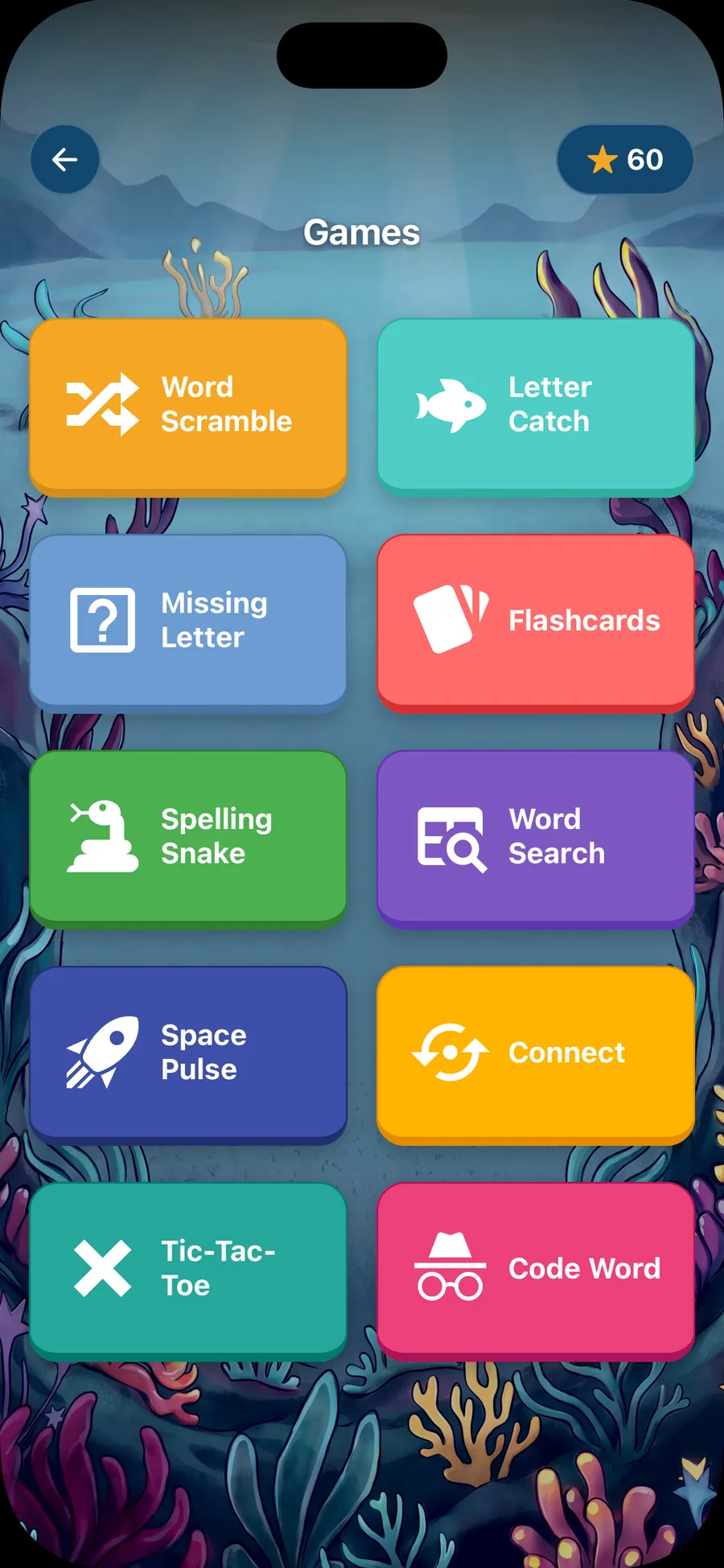
- During the week. Students play at school and at home. In Scramble they put the letters back in order, so the two letters of the digraph have to sit side by side. Missing letter takes a letter out of each word, and when it’s one half of a digraph, students have to remember its partner. Flashcards asks them to spell the word out loud before they flip the card. The Hear it button plays a word again as often as a child needs.
- Thursday. Sort the week’s words by digraph on the whiteboard, then add one new word to each group.
- Friday. Test the words the way you usually do. Next Monday, edit the list and the same link opens the new words.
For Foundation, keep to the six-word set and play each word together before anyone plays alone. Each list gets its own link, so a group that is ready for wh can have a different list from a group still on sh and ch. How the class link works in Australian classrooms
Where digraphs sit in the Australian Curriculum
In the Australian Curriculum v9.0 English, digraphs are first named in Year 1, in the sub-strand Phonic and word knowledge:
- AC9E1LY11: “use short vowels, common long vowels, consonant blends and digraphs to write words, and blend these to read one- and two-syllable words”.
- AC9E2LY10: “use phoneme–grapheme (sound–letter/s) matches, including vowel digraphs, less common long vowel patterns, consonant clusters and silent letters when reading and writing words of one or more syllables, including compound words”.
Year 2 builds on Year 1 with vowel digraphs and silent letters, such as the wr in write. For more lists by year, see the Foundation spelling words, the Year 1 spelling words (with a list for sh, ch and th, and one for ck) and the Year 2 spelling words. New South Wales and Victoria publish their own English syllabus and curriculum, so check any order against your school’s scope and sequence.
Sources: Australian Curriculum v9.0 English, F–6 content, Australian Curriculum v9.0 English glossary.
© Australian Curriculum, Assessment and Reporting Authority (ACARA) 2010 to present, unless otherwise indicated. This material was downloaded from the Australian Curriculum website (Website) (accessed 14 November 2026) and was not modified. The material is licensed under CC BY 4.0. Version updates are tracked in the ‘Curriculum version history’ section on the ‘About the Australian Curriculum’ page of the Australian Curriculum website. ACARA does not endorse any product that uses the Australian Curriculum or make any representations as to the quality of such products. Any product that uses material published on this website should not be taken to be affiliated with ACARA or have the sponsorship or approval of ACARA. It is up to each person to make their own assessment of the product, taking into account matters including, but not limited to, the version number and the degree to which the materials align with the content descriptions and achievement standards (where relevant). Where there is a claim of alignment, it is important to check that the materials align with the content descriptions and achievement standards (endorsed by all education Ministers), not the elaborations (examples provided by ACARA).
Questions
What is the difference between a digraph and a blend?
In a digraph, two letters spell one sound, as sh does in shop. In a blend, each letter keeps its own sound, as s and t do in stop. Count the sounds to tell them apart: shop has three, stop has four.
Is th one sound or two?
th is one digraph with two sounds. It’s unvoiced in thin and thank, where your throat stays still, and voiced in this and them, where it buzzes. Both are spelt th, so children don’t have to choose between spellings.
Is ck a digraph?
Yes. The c and k together spell one sound, the k at the end of words such as duck and clock. It comes straight after a short vowel.
Which year are digraphs taught in Australia?
The Australian Curriculum v9.0 English names digraphs in Year 1 (AC9E1LY11), and Year 2 adds vowel digraphs such as ai and ee. The Foundation set on this page suits classes that start sh, ch and th earlier.
How do I give these words to my class?
Press Make it a class list under a set. After a free sign-up, the list opens with those words in it, and you can change any word before you share the link. Students open it in any web browser, with no login.